Most PI firms assume a shortfall in signed cases is a lead problem. Often, the larger opportunity is a yield problem inside Intake Operations: firms are already paying to create demand, but too much of that value disappears between first contact and signed case, often at the Handoffs between people, systems, and stages of work.
That is the problem Intake Yield Management is meant to name. It is not a slogan, a software feature, or a fresh label for an old workflow. It is the discipline of continuously improving intake performance by identifying, classifying, and preventing avoidable loss between first contact and signed case.
Existing software helps firms run the practice. LexSteer helps firms continuously improve it.
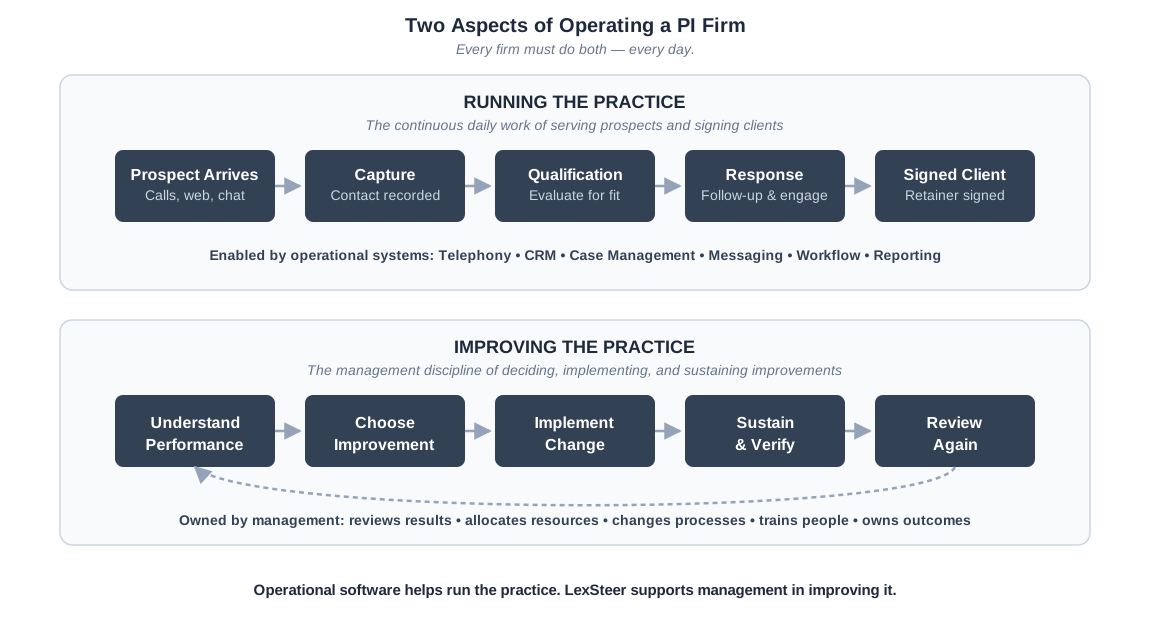
The point of naming the discipline is not to invent a category for its own sake. It is to give firms a more accurate way to describe what they are already experiencing: paid‑for opportunities are being lost before retainer, different kinds of loss are getting mixed together, and improvement efforts often happen without a shared language for what is actually broken.
The discipline sits above three specific tools LexSteer provides — Visibility, Operational Governance, and the loss taxonomy itself — each with its own job in making the discipline practicable, not just definable.
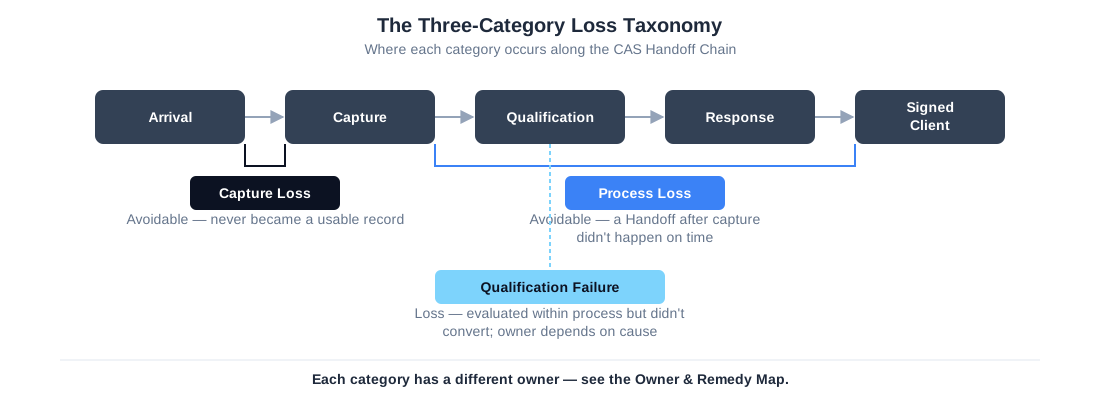
That taxonomy exists because “loss” is not one problem: Capture Loss, Process Loss, and Qualification Failure each have a different owner and a different Remedy, and each one surfaces at a specific point along the same chain.
The lineage behind the term
The term “yield management” has real operational ancestry, and it is worth tracing carefully rather than gesturing at it, because the skeptical reader’s first instinct will be to assume the word was chosen for its ring rather than its substance.
Airlines built the discipline first. Deregulation in the late 1970s left carriers holding a genuinely strange kind of inventory: a seat that is empty when the door closes is not merely unsold, it is gone, and it can never be sold again. That single fact — value that expires on a fixed clock regardless of what the airline does next — forced the industry to build forecasting, overbooking, and differentiated-pricing systems whose entire purpose was to capture as much of that perishable value as possible before it vanished. The rise of computerized reservation systems in the 1980s made that discipline systematic rather than intuitive. It is worth noting candidly that most airlines have since migrated their own internal language from “yield management” to the broader term “revenue management,” reflecting a shift from managing a single perishable resource toward optimizing total network revenue across many variables. Hospitality never made that same shift. Hotels still talk about yield management directly, because a room night is an even purer case of the same problem: unlike an airline seat, which can sometimes be resold at the gate, an unsold room is unsold the moment midnight passes, with no recovery mechanism at all. That the term persists in one industry and has been partly superseded in another is not a weakness in the lineage. It is evidence that the underlying idea is being actively refined by practitioners who take it seriously, not treated as a fixed piece of jargon.
Manufacturing arrived at a structurally different but philosophically related insight. The quality and continuous‑improvement movement that reshaped manufacturing in the mid-to-late twentieth century — most visibly through the Toyota Production System and the broader lean and Six Sigma traditions that followed it — rejected the idea that growth comes primarily from running the line faster or building more capacity. Instead, it treated defects, rework, and waste inside the existing process as the primary target, on the logic that a plant recovering value already being lost inside its own process is a better investment than a plant simply producing more units into the same leaky process. That is a materially different lineage from airline yield management — it is about loss inside a process rather than perishability of a discrete unit of inventory — but it converges on the same conclusion: protecting value already created is often the higher-leverage move, and it requires classifying failure by cause rather than treating all shortfalls as one undifferentiated problem.
Hospitals contributed a third strand: patient‑flow management, the discipline of moving people safely and efficiently through multi‑stage, time‑sensitive operations where a delay at one handoff — triage to bed, bed to specialist, specialist to discharge — can compound into harm or cost further down the chain. Hospital systems learned that aggregate throughput numbers can look acceptable while individual patients still experience dangerous bottlenecks at specific transition points, which is why patient‑flow work focuses on identifying and governing those specific transitions rather than managing to an average.
Logistics networks supplied the fourth strand, focused on capacity and load optimization: the recognition that a fixed network of trucks, routes, and warehouse slots produces more value by improving utilization, timing, and handoff coordination across the existing network than by simply adding more vehicles to a system that is already losing efficiency at known chokepoints.
None of these four lineages is identical to PI intake, and Intake Yield Management should not overclaim a single tidy ancestor. But all four converge on the same operating principle: growth does not come only from generating more demand or more volume. It also comes from preserving more of the value already created inside a time‑sensitive, multi‑stage system — and doing that requires seeing where value is being lost, correctly attributing why, and governing the specific points where loss actually occurs.
Why PI intake fits the pattern
PI intake has the same structural shape as these adjacent systems. The opportunity is perishable, the work is multi‑stage, the chain is handoff‑heavy, and the cost of loss is often hidden behind aggregate conversion reporting — the same blind spot that patient‑flow and manufacturing disciplines had to solve for before they could improve anything.
The inventory here is not seats, rooms, trucks, or units on a line. It is paid‑for demand: prospects who have already called, clicked, texted, or filled out a form, and whose value decays as response slows, Handoffs fail, or follow‑up weakens.
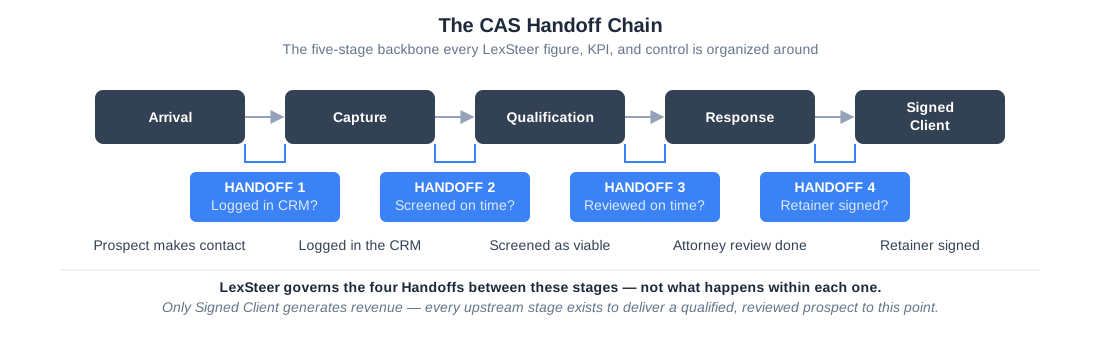
A prospect does not move from ad click to signed retainer in one clean step. The opportunity passes through capture, first response, callback, review, attorney screening, retainer follow‑up, and other Operational Transitions where responsibility may change hands and where delays can quietly destroy value. Those are exactly the conditions under which firms need a discipline rather than a loose collection of tools and local habits.
That is why Intake Yield Management should be understood as a discipline, not as a software label. The problem is larger than software alone. A firm needs a way to identify avoidable loss, distinguish one type of loss from another, govern critical Handoffs, and keep improvements from fading after the first round of change.
What the discipline actually does
At its core, Intake Yield Management gives firms a way to manage intake as a yield problem rather than a vague conversion problem. Conversion rates describe outcomes. They do not reliably explain whether the underlying loss came from Capture Loss, Process Loss, or Qualification Failure, and those are materially different problems with different owners and different Remedies.
Practicing the discipline means doing several things together:
- Making loss visible so the firm can see where opportunities are disappearing instead of arguing from anecdotes or aggregate conversion results.
- Classifying loss correctly so Capture Loss, Process Loss, and Qualification Failure are not treated as one undifferentiated failure bucket.
- Governing critical Handoffs so the moments most likely to destroy yield are watched, escalated, rerouted, and verified rather than merely assigned.
- Sustaining gains over time so improvements do not erode as staffing changes, workloads shift, and Operational Drift returns.
- Continuing the cycle so one solved bottleneck becomes the foundation for the next improvement rather than the end of the work.
This is why Intake Yield Management should also be understood as a discipline of Continuous Operational Improvement. It is practiced over time, on live operations, against perishable opportunities, with the goal of preserving more yield from demand the firm already paid to create.
The mechanism beneath the discipline
Intake Yield Management is the category. Its mechanism is Visibility and Operational Governance — but Visibility’s own reach runs a step further than Intake Yield Management’s does. Visibility diagnoses where value is being lost and, at the architecture level, whether the constraint is even inside intake to begin with, before Intake Yield Management’s own work starts. Operational Governance is what keeps the fix in place once management has acted.
Visibility gives the firm a factual picture of where loss is occurring, what kind of loss it is, and what it may be worth to recover. It turns intake underperformance from a debate into evidence.
Operational Governance addresses the second half of the problem. Once a firm understands where yield is being lost, Operational Governance governs critical Handoffs against explicit timing and ownership rules, detects stalled work, reroutes or escalates when needed, and verifies that recovery actually occurred.
Together, Visibility and Operational Governance allow a firm to practice the discipline rather than merely talk about it. Visibility answers where value is being lost and gives management the evidence to diagnose why. Operational Governance helps make sure the improvements chosen by management hold under real operating conditions.
Operational Governance now includes a way to demonstrate that it held, not just assert it. Operational Playback lets a firm move backward through its own operational history and see, at any chosen moment, exactly what the system state was and what LexSteer was doing about it. That turns “we govern the Handoffs that matter” from a claim a firm has to take on faith into something a managing partner can watch happen in the firm’s own data.
Why the name matters
A firm that lacks a name for this problem usually defaults to weaker language. It says intake has a conversion issue, a follow‑up issue, or a lead-quality issue, even when those labels collapse several distinct causes into one vague outcome metric. The result is predictable: agencies, intake teams, consultants, and leadership can all look at the same conversion number and draw different conclusions.
Naming the discipline changes that conversation. It reframes disappointing signed-case results from “we need more leads” to “we may need better yield on the demand we already paid for.” It gives managing partners, COOs, and intake leaders a shared language for talking about Source of Loss, Handoffs, Diagnosis, Remedies, and sustained improvement.
That matters strategically because firms do not need to confuse seeing the problem with fixing it. They need to see the problem clearly, understand what kind of loss they are dealing with, choose the right Remedy, and then make sure the gain holds.
Why this is not just marketing
The strongest objection to a new term is usually the simplest one: if the work is real, why name it at all? The answer is that the discipline already exists in substance whether or not the legal industry has named it clearly. Other industries learned long ago that avoidable loss inside a time‑sensitive, multi‑stage operation is not background noise. It is a management problem with its own methods, vocabulary, and economic logic.
PI intake has historically lacked that same explicit framing. Marketing has its own language. Trial work has its own language. Intake has too often been left as a black box managed through fragmented reports, task queues, staff effort, and after-the-fact explanations. Naming Intake Yield Management gives the industry a clearer way to describe the problem and a stricter standard for what real improvement should look like.
That standard is testable. Can the firm see where loss actually occurs? Can it distinguish Capture Loss from Process Loss and Qualification Failure? Can it govern the Handoffs that destroy yield? Can it prevent improvement from decaying into Operational Drift? If the answer is yes, the discipline is real. If not, the label does not matter.
How this article should change the reader’s lens
By the end of this article, a reader should see Intake Yield Management as a serious operational discipline applied to PI intake, not as a marketing phrase attached to software. The term names a real problem: preserving more value from paid-for demand across a perishable, handoff-heavy sequence between first contact and signed case.
A reader should also understand the site architecture more clearly. Intake Yield Management is the discipline. Visibility and Operational Governance are the mechanism beneath it. The Visibility Pack and Governance Pack are how LexSteer helps firms practice that discipline in live operations.
With that foundation in place, the next question is not whether the phrase sounds elegant. It is where intake loss actually shows up inside a PI firm, why time changes the economics of each opportunity, and how a firm should manage that perishability instead of merely buying more demand.