Almost every firm that has meaningfully improved intake can point to a period when the operation genuinely got better. Response times improved. Follow-up became more consistent. A new process was documented. A queue was cleaned up. Signed cases rose. For a time, the system felt tighter and more deliberate.
And then, in many firms, something quieter happens. The improvement does not collapse in a dramatic way. It thins out. Response times begin to widen again. Exceptions are handled less consistently. Small workarounds appear. A step that used to be followed every time becomes followed most of the time. Nobody can point to a single day the system failed, but months later leadership is looking at weaker results and wondering why something that once worked no longer seems to hold.
That is the problem this article addresses. Operational improvements rarely disappear because the original idea was always wrong. More often, they fade because operations are living systems. Staff change, priorities shift, local habits re-emerge, and institutional memory weakens. Without a mechanism to recognize that drift early and respond appropriately, the gains from a good intervention slowly leak back out of the organization.
Why improvements decay
The most common causes of fading performance are ordinary, which is part of what makes them dangerous. A strong intake leader leaves. A new hire never received the original context behind the process. Marketing volume changes and the team improvises around pressure. Attorneys develop local shortcuts. Managers start reviewing reports less frequently because another operational fire takes priority. A workflow designed for one stage of the firm’s growth no longer fits the current environment, but no one formally updates it.
None of these changes looks catastrophic by itself. That is the point. Improvement does not usually die from one spectacular operational failure. It erodes through small deviations that seem reasonable in isolation and expensive only in aggregate.
This is where the succession point becomes central rather than incidental. A process that runs because one managing partner, COO, or intake leader knows how to push it forward personally is not really an asset. It is a dependency. It does not scale cleanly, transfer easily, or survive absence well. Once the improvement depends on a particular person’s memory or vigilance, the countdown to decay has already started.
What Operational Drift really is
LexSteer uses the term Operational Drift for performance that quietly gets worse over weeks or months without any single obvious event that would force attention in the moment. That definition matters because it separates drift from ordinary one-off problems.
A one-time miss is not necessarily drift. A bad day, an unusual staffing gap, or a temporary volume spike may produce noise without changing the underlying operating condition. Drift is different. Drift means the system’s normal behavior is changing, usually in a negative direction, and leadership notices too late because aggregate outcomes blur the change.
This is why drift is such an expensive form of failure. It hides inside familiarity. Teams normalize slightly slower callbacks, slightly looser handoffs, slightly less consistent follow-up. Because no single event seems decisive, management adapts emotionally before it adapts operationally. By the time the effect is obvious in signed-case results, a great deal of Lost Pipeline may already be gone.
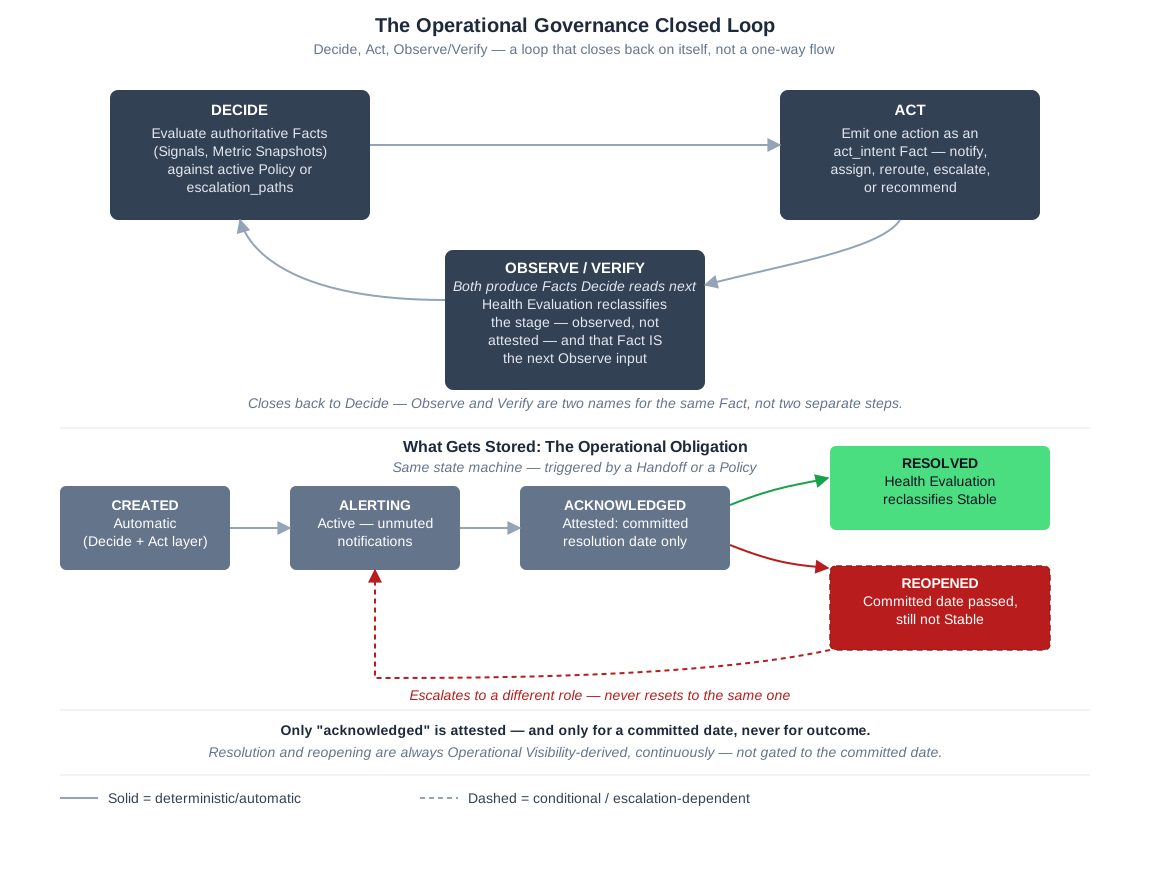
Operational Governance matters here because it is what keeps a successful change from quietly reverting back toward best effort.
Why events are not enough
Firms do not just need to notice events. They need to recognize patterns over time — which means distinguishing isolated misses from Stable behavior, an Improving or Deteriorating trend, and Unstable volatility.
This is the operating logic borrowed from statistical process control, translated into plain management language rather than charts. The point is not to turn PI firm leaders into quality engineers. It is to give them a clearer way to interpret what they are seeing.
A metric or Handoff pattern can be in one of four states:
- Stable — performance is holding within its expected range of variation; the right response is to maintain the standard and keep watching, not launch an investigation.
- Improving — performance is trending consistently better across six or more periods; not yet Stable, so the right response is to confirm what is driving the improvement and protect it, rather than assume it will hold on its own.
- Deteriorating — performance is still functioning, but moving consistently worse and will breach control limits if left alone; the right response is to intervene before the decline becomes expensive.
- Unstable — behavior has become volatile or erratic with an assignable cause: something identifiable happened; the right response is to investigate the specific weeks or events, not the process in general.
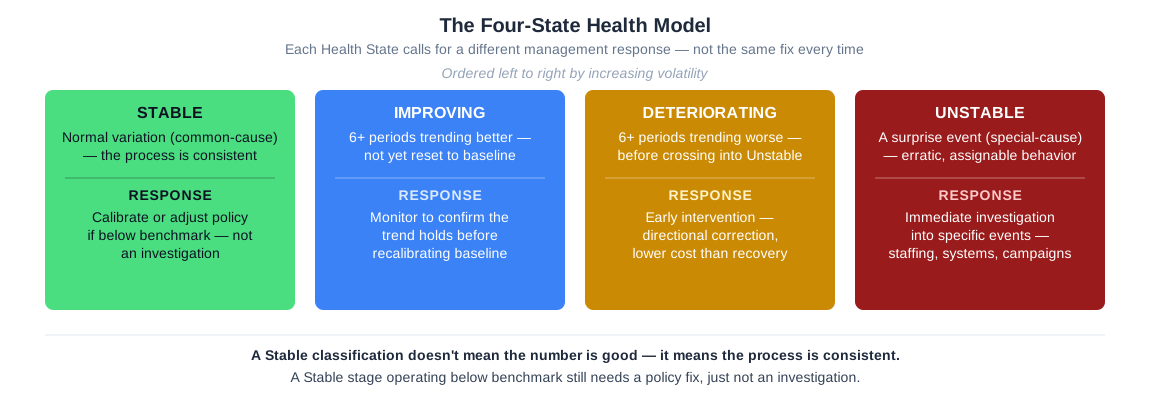
That distinction matters because each pattern calls for a different management response. If leadership treats every miss as an emergency, the organization becomes noisy and reactive. If leadership treats a Deteriorating trend as normal variation, the organization waits too long. If leadership assumes an Improving trend will simply continue on its own, it can quietly slide back to Deteriorating without anyone noticing the reversal. Pattern recognition improves judgment by helping management tell the difference between these four states rather than reacting to every data point as if it were equally significant.
Early warning is a management advantage
The real value of early warning is not merely that it sounds prudent. It changes what is still recoverable. Once drift is obvious in aggregate revenue or signed-case volume, many of the missed opportunities are already unrecoverable. Early warning matters because it allows the firm to correct while the issue is still mostly operational rather than already financial — ideally catching a Handoff while it is still Deteriorating, not after it has become Unstable.
This is where Visibility and Governance meet Continuous Operational Improvement. Visibility makes the key behaviors measurable. Governance keeps critical Handoffs from reverting silently. Pattern recognition tells management whether what it is seeing is Stable, Improving, Deteriorating, or Unstable. Together, those capabilities allow leadership to intervene in time rather than only explain afterward what went wrong.