Intake Yield Management is a discipline, not a feature. Like every discipline built to protect yield in a perishable, handoff-heavy system, it only works when three things are true at the same time: loss is visible in the right places, critical work is actually governed in live operations, and improvements do not quietly fade when staff, priorities, and circumstances change.
Visibility, Governance, and Continuous Operational Improvement are simply the names this library gives those three requirements. Visibility is how a firm stops guessing where its Lost Pipeline comes from. Governance is how a firm stops assuming that assigned work automatically became completed work on time. Continuous Operational Improvement is what turns one-time fixes into a long-term operating standard instead of a series of short-lived campaigns.
This article is about why all three matter together. Separately, each sounds like something a firm already does in some fashion. Together, they form the mechanism that turns Intake Yield Management from a convincing idea into a durable result.
Visibility: seeing loss where it actually occurs
Visibility, in this library, does not mean more dashboards or more graphs. It means knowing, with evidence, where cases disappear between first contact and signed case, and being able to attribute that loss to specific Sources of Loss: Capture Loss, Process Loss, and Qualification Failure.
That distinction matters because different loss sources have different owners and different Remedies. A case that never got logged anywhere is a Capture Loss; the remedy lives in how arrivals are captured and recorded. A case that entered the system but stalled at a callback, review, or retainer step is a Process Loss; the remedy lives in how Handoffs are managed and governed. A case that was followed up properly but was never going to convert is a Qualification Failure; the remedy depends on which of the Qualification Failure Dispersion Check’s three outcomes applies — lead quality (Qualification Failure — Lead Quality), an intake agent’s judgment or training (Qualification Failure — Judgment), or a shared, undetermined cause — not assumed by default to be a marketing-mix problem, and not solved by more pressure on staff.
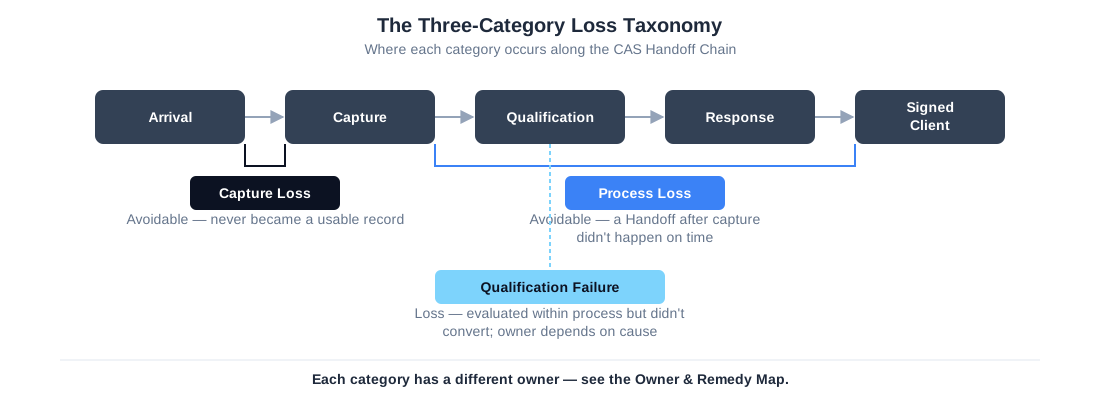
Standard conversion reporting collapses all three into a single outcome percentage. It tells a firm how much made it through, not where or why the rest did not. Visibility, as used here, is about separating those failure modes so leadership can stop treating “conversion” as one big, undifferentiated problem and start treating distinct sources of loss as separate, solvable operational issues.
That is why the Visibility Pack exists at all. It is not a prettier report. It is a structured look at 180 days of Multi‑Channel Intake Data, classified by where cases actually disappeared, so that a firm can see which loss modes are driving Lost Pipeline and in what proportions. Without that view, efforts to improve intake are often Remedies in search of a problem.
Governance: making sure critical work actually happens
Visibility is necessary, but by itself it does not save any cases. Knowing that a callback, review, or retainer step frequently stalls does not, on its own, make the next one occur on time. That job belongs to Governance.
Governance, in LexSteer’s language, is the system that makes sure critical intake Handoffs actually happen when they are supposed to, and steps in when they do not. A Governed Handoff is one that is being watched against a clearly defined timing expectation. When that expectation is missed, the system does more than log the delay. It evaluates what the stall means, escalates or reassigns according to the firm’s own rules, and then verifies whether the response actually closed the gap.
Flag, evaluate, act, confirm. That closed loop is the difference between monitoring and Governance. A dashboard or alerting system that only flags stalled work has told the firm that something happened. It has not done anything about it, and it has not checked whether anyone else did either. Governance begins at the moment the firm stops assuming that “flagged” and “handled” are the same thing.
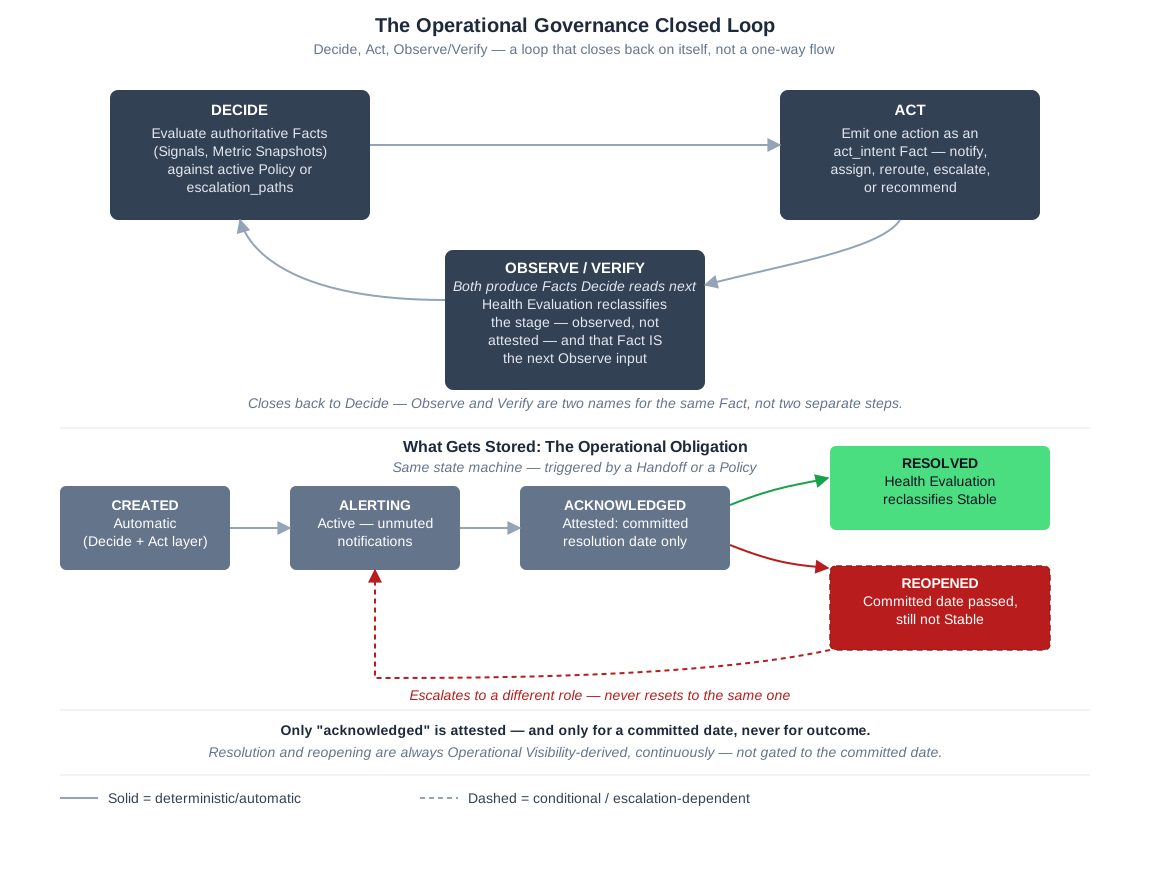
Consider what that looks like in practice. A callback is due at 2:00 PM. By 2:15, it has not been logged as complete. A monitoring tool stops there — a red flag on a dashboard someone may or may not be watching. A governed system does something different: it checks whether the assigned owner is available, re-routes the callback to a backup owner according to the firm’s own rule if not, and confirms at 2:45 whether the backup actually reached the prospect. If the backup also fails, it escalates to a supervisor. Nothing about that sequence requires a person to remember to look. That is the entire distinction this article is built to explain.
Each response in that sequence — the reroute, the escalation — creates a specific, trackable commitment inside the system: an Operational Obligation. It is created automatically the moment the condition is detected, moves to alerting until someone commits to a resolution date, and then resolves the moment Visibility itself observes that the underlying condition has actually cleared — or reopens and escalates to a different role if that committed date passes first without resolution. Nothing about closing an Obligation is taken on anyone’s word; it is read from the same Visibility layer that detected the problem in the first place. And because each state leaves a stored record, a firm does not have to take the claim on faith. Operational Playback lets a firm move backward through its own operational history and see, at any chosen moment, exactly what stalled and what the system did about it.
This is why Governance is presented as a mechanism, not a category of its own. It is the practical, day‑to‑day governance layer that makes an intended intake design real in operations. It sits beneath the category of Intake Yield Management the same way patient-flow coordination sits beneath hospital quality programs: invisible when it works, expensive when it is missing.
Continuous Improvement: keeping fixes from fading
Even with Visibility and Governance in place, a firm that treats improvement as a one‑time project will watch its gains erode over time. Staff change. Volumes shift. New marketing channels arrive. Old workarounds reappear. What started as a crisp operating standard can quietly turn into a loose collection of local habits again.
This library calls that erosion Operational Drift: performance that quietly gets worse over weeks or months without any single dramatic event that would force attention in the moment. Drift is difficult to see in aggregate reporting because overall conversion can remain stable while a specific stage is slowly degrading, or because changes in case mix and volume mask emerging weaknesses.
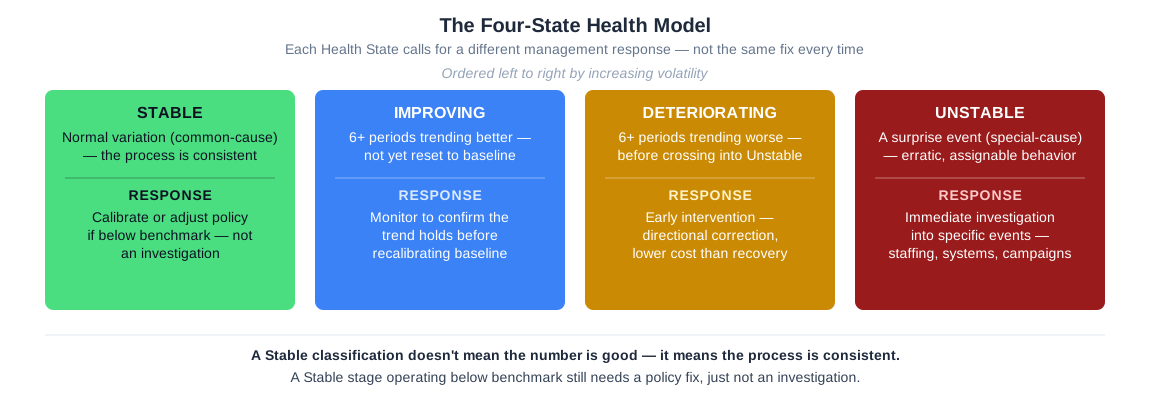
Recognizing drift early depends on more than noticing a single bad week. It requires distinguishing ordinary noise from a genuine change in the system’s underlying behavior. This library classifies that behavior into four states: Stable, meaning performance is holding within its expected range and the right response is simply to keep watching; Improving, meaning a Handoff or metric is trending in the right direction and the right response is to confirm the cause and protect it; Deteriorating, meaning performance is still functioning but moving the wrong way, and the right response is to intervene before the decline becomes expensive; and Unstable, meaning behavior has become volatile or erratic enough that the underlying process itself may be unreliable, calling for deeper investigation rather than a routine fix. Treating every miss as an emergency exhausts a team; treating a Deteriorating trend as normal variation lets real loss accumulate quietly. The four-state model exists to keep leadership from doing either. Why Operational Improvements Fade: Drift, Patterns, and Early Warning covers this classification in full.
Continuous Operational Improvement, in this context, does not mean endlessly re‑inventing intake. It means treating each fix as part of an ongoing cycle: Visibility identifies and quantifies a Source of Loss; the firm chooses a specific improvement, not just a Remedy; Governance makes sure the new standard holds in live operations; and then the same Visibility and Governance infrastructure is used to detect whether performance is drifting again.
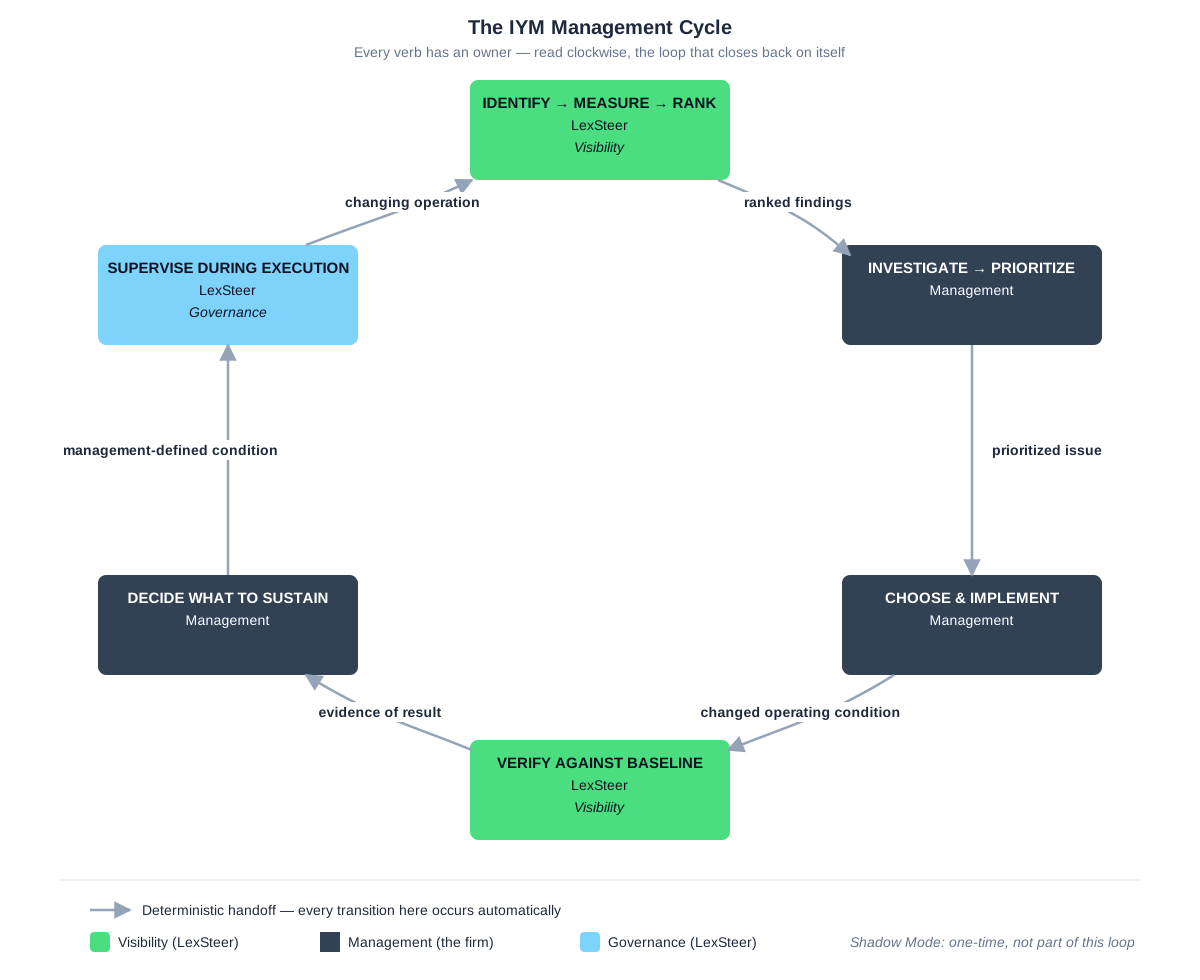
Over time, that cycle matters as much as any single improvement. Without it, even well‑designed interventions fade — especially when they depend on one person’s memory or presence. With it, the firm begins to build something closer to an asset: an intake operation whose behavior is controlled by an explicit standard and a system that keeps it from silently unraveling.
Why all three matter together
Each of the three concepts has its own logic. Visibility corrects misdiagnosis. Governance corrects the assumption that assignment equals completion. Continuous Operational Improvement corrects the assumption that a fix that worked once will continue to work without active stewardship.
Their real power, though, lies in how they interact.
Visibility without Governance can describe the problem but cannot prevent a known failure from recurring in live operations.
Governance without Visibility can enforce the wrong things, or enforce them in the wrong places, because it is working off assumptions rather than evidence.
Both, without a Continuous Improvement posture, can still allow Operational Drift to undo past gains slowly enough that leadership only notices after significant Lost Pipeline has accumulated.
When all three are present, the firm’s relationship to intake changes. Intake is no longer a black box that occasionally underperforms. It becomes a system whose behavior is legible, whose critical Handoffs are explicitly governed, and whose performance over time is something leadership can manage deliberately instead of react to episodically.
What this mechanism does not replace
It is worth being explicit about what this article does not argue, because the objection is predictable otherwise. It does not argue that a firm’s CRM, marketing agency, consultants, or staff become unnecessary once Visibility and Governance are in place. Those layers still do the work they were built to do — generating demand, storing records, redesigning process, executing repetitive tasks. This mechanism does not compete with any of them for that job.
What it argues is narrower: none of those layers was built to answer the specific question of whether a critical Handoff completed on time, and none of them was built to notice, on its own, when a fix that worked in March has quietly stopped working by September. That is a distinct job, not an extension of an existing one, which is why it needed its own name rather than being folded into “better reporting” or “a stricter CRM configuration.” A firm that already has excellent people and excellent tools can still be missing this layer — in fact, that is the more common case, because strong execution in every individual layer is exactly what makes a firm confident enough to stop asking whether the layer connecting them still exists.
That is what this tier means by “mechanism.” Not a particular product architecture or software diagram, but a specific way of operating: seeing loss clearly, governing critical transitions, and keeping improvements from fading in the ordinary turbulence of a growing PI practice.
What this tier covers
- Visibility Before Action — why diagnosing the Source of Loss has to come before choosing a Remedy, not after.
- Governed Handoffs and Closed-Loop Operations — what it actually means for a Handoff to be watched, recovered, and verified rather than merely assigned.
- Why Operational Improvements Fade: Drift, Patterns, and Early Warning — the four-state model in full, and why events alone are not enough to catch drift in time.
- Why Drift Gets More Expensive as Firms Grow — a worked example of the same drift, illustrating why the same decay that’s cheap to catch at five attorneys is expensive to catch at fifteen.
- The Missing Layer in Modern Intake Operations — why a fully-stocked tool stack still leaves this mechanism missing, and why that gap grows more costly as a firm scales.