AI has quickly become one of the most talked-about answers in personal injury intake, and for a real reason: it can respond faster than most teams, qualify basic facts consistently, handle high volumes of repetitive communication without fatigue, and extend responsiveness outside ordinary staffing hours. In a workflow that often suffers from delay, inconsistency, and administrative overload, that is a genuine upgrade.
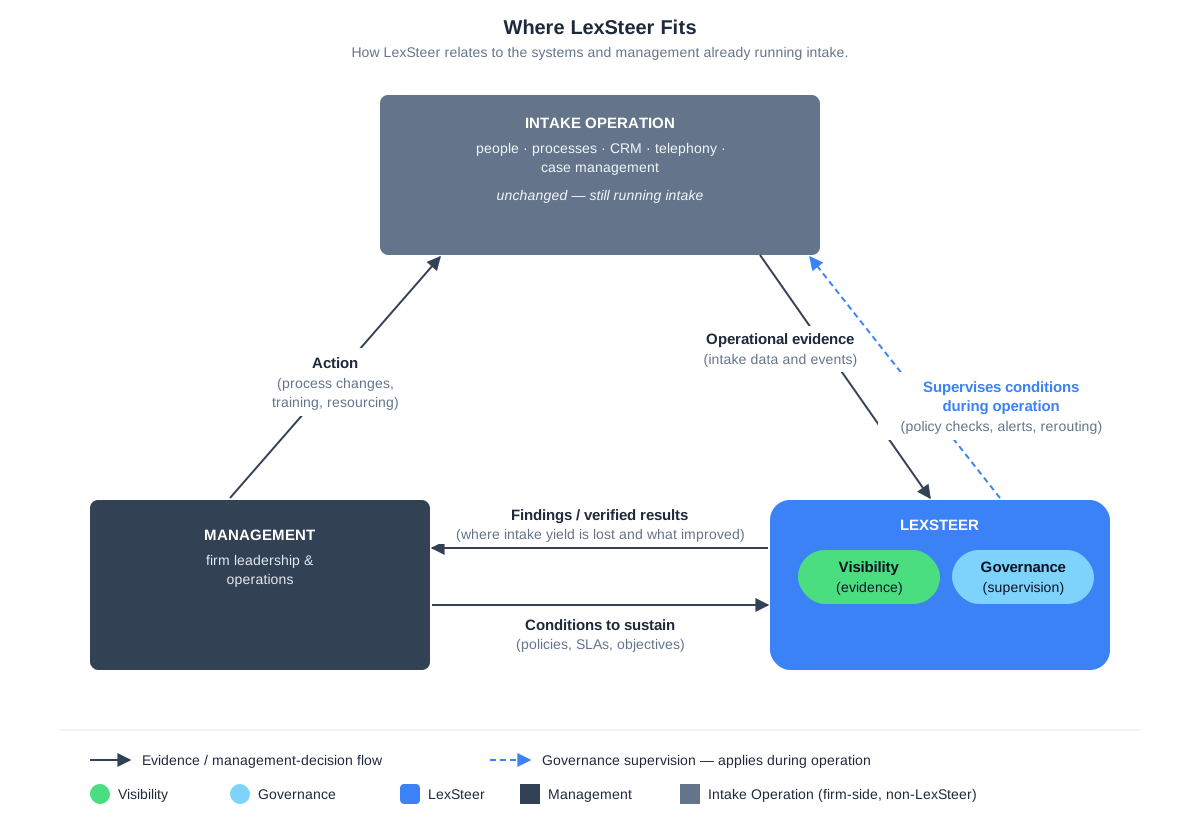
It is also, categorically, an upgrade to running the practice — the same job a CRM, an automation platform, or a call center does. AI can make that job faster and more consistent. It cannot, by itself, do the other job: improving the practice, which is the discipline of finding where intake is leaking and making sure the fix holds. AI is excluded from that job for a sharper reason than the other tools in this tier: the layer that does it has to be deterministic, repeatable, and explainable — a property of how a system is built, not how intelligent it is. Running the practice and improving the practice are different jobs, and AI — however capable — belongs in the first one.
Where AI genuinely helps
Used well, AI improves several bounded parts of intake: answering common questions, collecting basic facts, triaging straightforward inquiries, supporting scheduling, and maintaining fast communication across channels. In a perishable-demand environment, that matters — speed itself protects value, and consistency at the front end, never forgetting to ask the same opening question or delaying an acknowledgment, is a real, measurable improvement over human variability.
That is running the practice done better. It is not the same thing as improving it.
Why AI can’t be the improvement layer either
It is worth asking directly: if AI can already draft, triage, and route, why not have it own the governance layer too — detect a stalled Handoff, decide what to do, and verify recovery? The answer is not that AI isn’t capable enough yet. It is that the improvement layer needs three specific properties AI does not reliably provide, no matter how good the model gets.
Determinism. A governed Handoff has to behave the same way every time a given condition is met — the same missed callback always reroutes to the same backup path, on the same schedule. A model that produces a plausible, well-reasoned action most of the time, but not provably the identical action every time, cannot be the mechanism a firm depends on to close a loop reliably.
Repeatability. A firm needs to be able to go back through its own history and see, at any past moment, exactly what happened and why — and know that if the same conditions occurred again, the same thing would happen again. That guarantee is what makes a Handoff’s record evidence rather than anecdote. A probabilistic decision-maker can describe what it happened to do once. It cannot promise what it would do next time under the same conditions, which is the whole point of a control system.
Explainability. When a case stalls and something intervenes, a managing partner has to be able to point to the specific rule that fired and why — not a generated rationale that sounds right after the fact, but the actual, named reason the system acted. That is a different kind of explanation than a model producing a plausible justification for its own output, however articulate the justification sounds.
None of this is a maturity problem that improves with a better model. It is a structural mismatch: governance requires provable, repeatable, rule-traceable behavior, and that is a property of how a system is built, not how intelligent it is. This is also why Operational Governance is built on deterministic, rule-based logic rather than on a model’s judgment — not because rules are simpler, but because they are the only thing that can be replayed, verified, and explained on demand.
That constraint sits on Deciding and Acting, not on Observing. Classifying a messy call transcript — for example, to help judge whether a Qualification Failure looks like a lead-quality problem, an individual agent’s judgment call, or a shared cause across the team — is a different kind of task from deciding what to do about a stalled Handoff. It feeds evidence into Visibility rather than issuing a governed action, so it never has to clear the D/R/E bar above. LexSteer is AI-enabled in its own development and expects to use AI tools in running the business the same way, including for exactly this kind of classification work alongside the existing Qualification Failure Dispersion Check. That is illustrative of where AI fits, not a confirmed or shipped feature today — but the underlying principle holds regardless of which specific use case arrives first: AI can sit inside Observe without ever being asked to perform Decide, Act, or Verify.
Doesn’t an AI-native platform replace this?
AI-native systems of record are starting to describe themselves the same way LexSteer does — observing activity, recommending action, executing with an audit trail. That’s not a contradiction of the argument above; it’s the argument arriving somewhere else too. Look closely and the pattern holds: action still happens inside a deterministic, rule-gated layer, with AI doing the drafting or triage upstream of it. The distinction that matters was never “can a system observe and act” — everyone is converging on that shape now. It’s whether the layer doing the deciding understands what a PI intake loss actually is: which of three distinct causes produced it, what it’s worth, and what specific obligation closes it. A general-purpose operating layer built for law firm activity broadly has no reason to encode that domain semantics, and that gap doesn’t close as everyone else’s AI gets better.
It also raises a fair question the other way: if a firm adopts one of these AI-native platforms outright, does it still need LexSteer? The two aren’t substitutes. An AI-native CRM or intake platform, however capable, is still one tool among several a firm actually runs — telephony, document systems, referral agencies, case management — and it can only see and verify its own slice of that stack. It also can’t be the thing that checks its own work: a system that takes an action has a structural blind spot in grading whether that action actually held, the same reason a firm’s own staff can’t be the last check on their own handoffs. LexSteer’s job doesn’t compete with what any one platform does, AI-native or not — it watches the seams between whatever tools a firm runs, and verifies outcomes independently of the system that produced them.
What this means for Intake Yield Management
AI has a real, growing role in Intake Yield Management — inside running the practice, where speed and consistency compound directly into preserved yield. But the discipline’s distinct work is improving the practice: finding where cases leak, governing the Handoffs that determine whether they’re recovered, and proving that the fix held. That job depends on the three properties above, which is why it stays built on Visibility and Operational Governance rather than on a model, however capable that model becomes at everything around it.