A great deal of intake loss occurs at moments that feel too ordinary to deserve a name. A call note is waiting for review. A signed-interest prospect is waiting for a callback. A case is in queue for attorney screening. A retainer went out, but no one followed up after the first delay. Nothing in those moments looks dramatic. Yet those are the places where paid-for demand most often turns into Process Loss, because responsibility is moving from one person, team, or system to the next and the move does not complete the way leadership thinks it does.
That is why LexSteer’s core operating language centers on the Handoff. A Handoff is the moment a prospect’s case moves from one owner, team, or system to another, and it is the point where work most often becomes ambiguous, delayed, or silently abandoned. The reason to focus there is not stylistic. It is because Handoffs are where “someone should handle this” and “someone actually did handle this on time” diverge most often in real operations.
This article explains what it means to govern those moments and why Closed-Loop Operations matter. The short version is simple: a reliable system does more than assign responsibility. It watches critical Handoffs against explicit timing expectations, responds when the intended move does not happen, and verifies whether the response actually restored flow. That is the difference between best effort and governed execution.
Why some Handoffs matter more than others
Not every movement inside Intake Operations deserves the same level of attention. Some transitions are administratively useful but not yield-critical. Others are load-bearing. They determine whether a paid-for opportunity is still alive, still reachable, and still moving toward a signed case within the time window where value has not yet decayed.
A Handoff becomes operationally critical when three conditions are present: it moves the case into the next necessary stage, delay at that point materially lowers the probability of conversion, and ownership becomes unclear or breakable when the move does not happen as intended.
Examples are easy to imagine: initial callback after intake capture, routing a qualified matter into attorney review, retainer follow-up after interest has been established, or reassignment when the original owner has not acted in time. The exact set varies by firm, but the underlying principle does not. A critical Handoff is one where delay is not just inefficient; it is yield-destructive.
This is also why “monitoring tasks” is too weak a description. The issue is not whether activity exists in a system. It is whether the transition that preserves the case actually happened.
What makes a Handoff governed
A Governed Handoff is not simply a Handoff with a reminder attached. It is a Handoff watched against a defined timing expectation, with clear ownership and an explicit rule for what happens if the intended owner does not respond in time.
That rule matters because Operational Governance is not just awareness. A delayed Handoff does not become governed the moment someone notices it in a dashboard or mentions it in a meeting. It becomes governed when the system can do three things reliably: detect that the Handoff missed its expected timing, trigger a response based on the firm’s rules, and verify whether that response actually closed the gap.
There is an important sequencing point here: the first response to a missed Handoff should usually be re-routing to a backup owner or alternate path according to the firm’s rules, not immediate escalation every time. Escalation remains necessary when the backup path also fails, but Operational Governance works best when it first tries to preserve flow through a defined recovery path before raising the issue upward.
That sequence is practical because not every stall is a management emergency. Some are simply ownership failures that need a backup route. What matters is that the case does not sit in ambiguity while the firm assumes that “someone must be on it.”
From assignment to recovery
This is where many intake systems stop too early. They assign the work. They may even timestamp the assignment. Some send reminders. But they still rest on a fragile assumption: once responsibility has been assigned, the operation will carry the case forward from there.
Closed-Loop Operations reject that assumption. They treat assignment as the start of accountability, not its conclusion. If the primary owner does not act in time, the system does not merely record lateness. It re-routes according to rule. If re-routing does not restore movement, it escalates. After intervention, it checks whether the case actually recovered.
This is the loop: expected move, detection of failure, triggered response, verification of recovery. Each step in that response — the reroute, the escalation — creates a specific, trackable commitment inside the system: an Operational Obligation. It is created automatically, moves to alerting, and is acknowledged only by a committed resolution date — never by a claim that the fix worked. It resolves the moment Visibility itself observes the gap has actually closed, or reopens and escalates to a different role if the committed date passes first. That is what separates a rule that fired once from a problem that was actually carried to resolution.
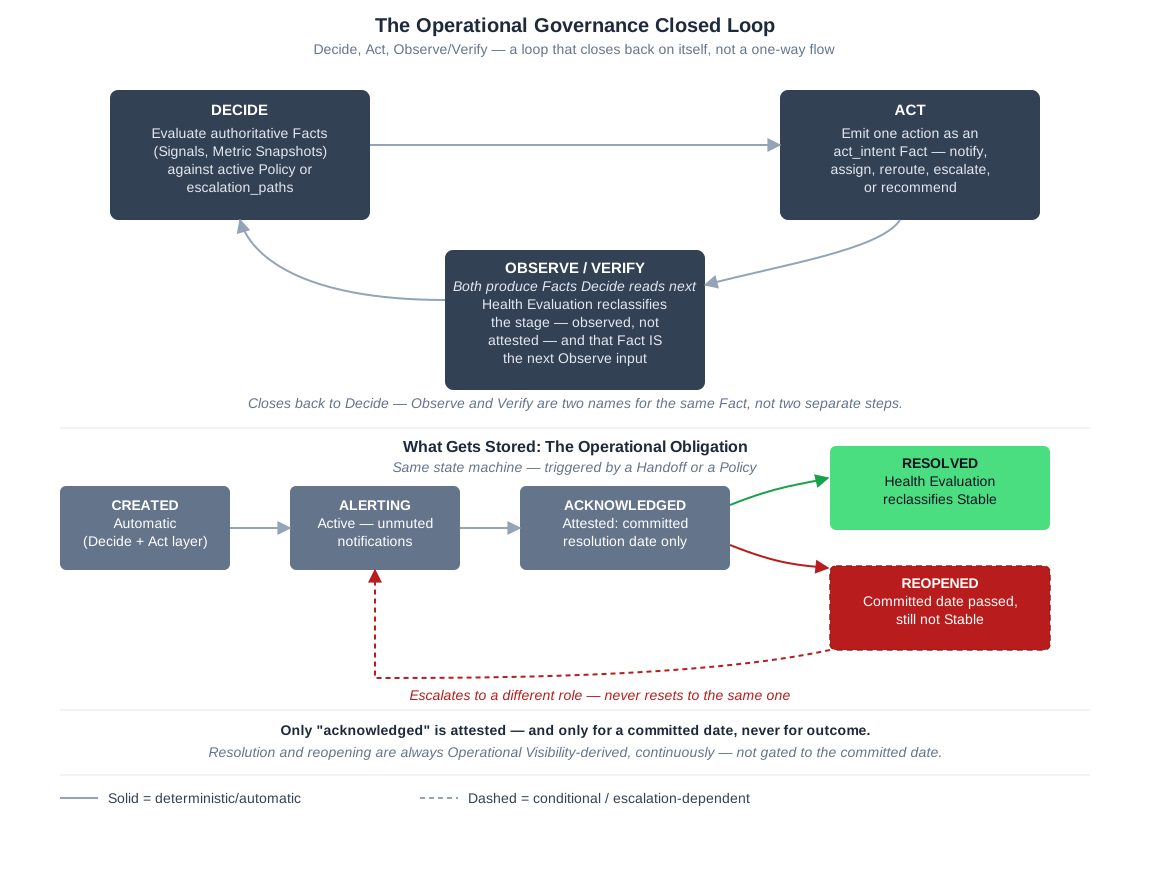
That is what “closed loop” means in operational language. Problems are not merely flagged. They are carried through to a known outcome. If the gap remains open, the system still has work to do.
This matters because a large amount of intake loss happens after the first miss, not at the first miss itself. The first failure may be recoverable. The real cost appears when no one knows whether recovery happened, so the case ages through a second or third failure point before leadership ever sees the pattern.
None of this needs to be taken on faith, either during a sales conversation or eighteen months into a live deployment. Because each state in an Operational Obligation’s lifecycle is a stored fact, a firm can use Operational Playback to move backward through its own operational history and see exactly when a Handoff stalled, what the system did about it, and whether the case actually recovered.
Why best effort is not enough
Many firms already have a human version of this layer. Experienced intake leaders check queues, chase delayed callbacks, remind attorneys, and notice when something feels stuck. Managing partners escalate problem cases from instinct. Team leads act as informal routing logic when staff are overloaded. None of that is imaginary. It is often the only thing holding yield together in a growing firm.
But this human-managed layer is usually incomplete, inconsistent, and not timely enough for perishable demand. It depends on memory, vigilance, personality, and availability. It is hard to scale, hard to transfer, and easy to disrupt when staffing changes or attention moves elsewhere.
That is the limit of best effort. Best effort can rescue cases. It cannot reliably govern a growing intake operation across every critical Handoff, every day, at the speed perishability requires. The issue is not whether the people care. The issue is whether the operating model depends on them noticing in time.