Most PI firms talk about leads as if they were a static asset. A lead arrives, sits in a system, and either converts or it does not. In practice, that framing hides the most important fact about intake: time quietly destroys value.
The longer a prospect waits without the right action, the less likely that opportunity is to become a signed case, no matter how good the eventual handling is. Intake is not just a volume problem. It is a perishable inventory problem, and the perishability of that inventory is what makes disciplined Intake Yield Management necessary rather than optional.
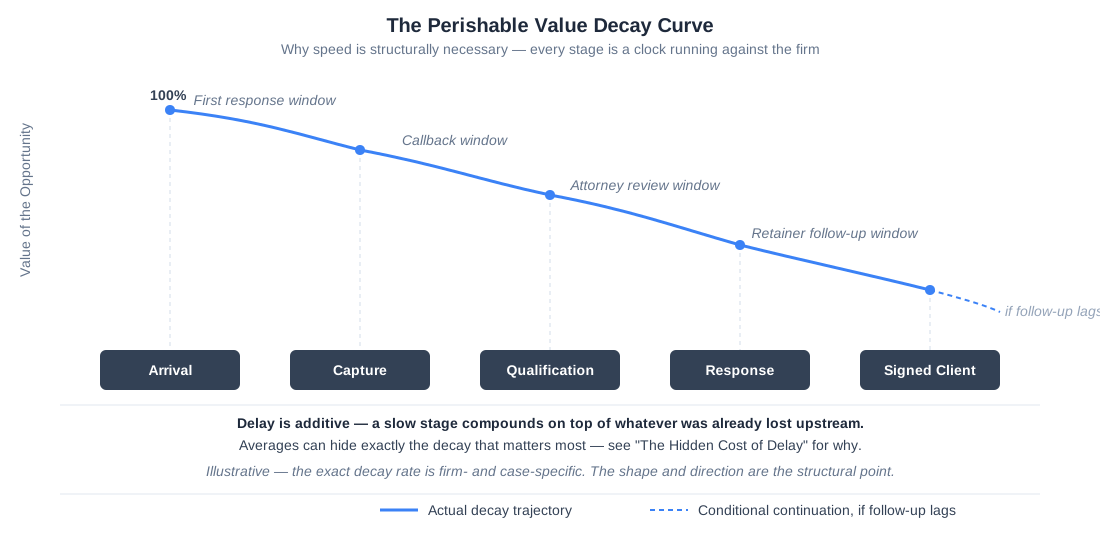
That decay is the clock every category of loss below is racing against.
What it means for demand to be perishable
In airlines and hospitality, perishable inventory means seats or rooms that lose all their value once the plane departs or the night passes. You cannot sell yesterday’s empty seat today. The only way to protect yield is to manage that inventory before it expires.
PI intake behaves the same way in slower motion. A prospect who has just been injured and is actively looking for representation is contacting multiple firms, under stress, and deciding on a short psychological and practical clock. As that clock runs, the prospect hires another firm, decides not to pursue a claim at all, becomes harder to reach, or simply loses the urgency and clarity needed to sign.
From the firm’s perspective, the result is the same as an empty seat that went unsold: paid‑for demand that quietly expires. The opportunity did not merely fail to convert. It passed out of the firm’s reach because value decayed faster than the operation responded.
Why speed is necessary but not sufficient
Once intake is understood as a perishable inventory problem, speed stops being a vague aspiration and becomes a structural requirement. Faster first response, faster callbacks, and faster movement into attorney review all improve the odds that the case is still alive, reachable, and willing to sign when the firm acts.
But speed on its own is not enough. Firms often treat speed as a generic KPI without asking which specific Handoffs are most sensitive to delay, and they assume fast‑on‑average is good enough even when many individual opportunities still sit too long at critical points. Perishable inventory logic is stricter than that. Certain stages are load‑bearing, and delay at those points is disproportionately yield‑destructive compared with delays elsewhere. Averages can hide the decay that matters most: a five‑minute average response time can still mean many prospects waited twenty or thirty minutes before anyone actually handled their case. Speed has to be applied where it matters most, and enforced Handoff by Handoff rather than left as a general aspiration.
How perishability connects to loss classification
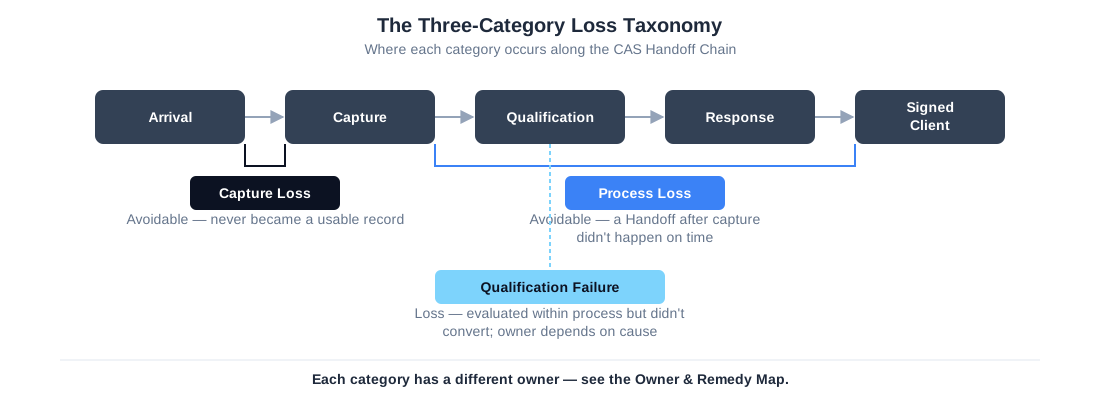
Once a firm accepts that intake is perishable, it becomes easier to see why aggregate conversion reporting is not enough. Firms do not lose all cases for the same reason. Some opportunities disappear as Capture Loss because the prospect contacted the firm but never became a usable record. Others become Process Loss because a callback, review, assignment, or other critical Handoff did not happen on time or at all. Others are Qualification Failure because the prospect was followed up with appropriately, but the case was never going to convert.
That distinction matters because each type of loss has a different owner and a different Remedy. A sourcing problem should not be treated like an execution problem, and an execution problem should not be dismissed as bad leads. It also explains why timing matters: when prospects are handled quickly, the firm gets a clearer read on outcomes that are genuinely Qualification Failure. As response slows, that read gets harder to trust, which is one reason Visibility has to come before management acts.
Why more leads do not solve a perishability problem
When signed‑case results disappoint, the common instinct is to buy more leads. That seems rational on its face — more cases in means more cases out. But if the firm is already losing a meaningful share of paid‑for demand because intake is slow or inconsistent at critical points, adding more demand simply feeds more inventory into the same fragile process. The firm spends more to generate opportunities that decay at roughly the same rate.
From a yield‑management perspective, that is the least efficient way to improve results. The better sequence is to understand where existing inventory is decaying, improve the operation so fewer opportunities expire unused, and only then decide whether adding more demand makes economic sense. That is the shift Intake Yield Management is trying to create: protect and improve yield first, then decide how much additional volume is truly worth buying.
Where perishability shows up in PI intake
Perishability is not an abstract idea. It shows up at specific, observable points in the operating chain:
- First response after contact. Prospects reached quickly are more likely to engage and less likely to have already committed elsewhere.
- Callbacks after messages or partial intakes. Delayed callbacks create room for doubt, frustration, or a competing firm to intervene.
- Movement into attorney review. Cases that sit in review queues too long lose urgency and signing willingness.
- Retainer follow‑up. A prospect who says yes in principle but never signs is another form of perishable inventory; delay lowers the chance of recovery.
Treating intake as perishable inventory means recognizing that time is not neutral in each of these stages — it is a force working against conversion.
How this connects back to Intake Yield Management
Intake Yield Management is the discipline built on this insight: it treats PI intake the way other yield disciplines treat seats, rooms, or network capacity — as a perishable resource whose value depends on how well a time‑sensitive, handoff‑heavy system actually behaves. That is why the discipline depends on both Visibility and Operational Governance. Visibility helps the firm see where perishability is turning into actual loss and what kind of loss it is. Operational Governance protects the critical Handoffs where delay, missed ownership, or stalled follow‑up most often destroy yield — together enabling Continuous Operational Improvement rather than episodic problem‑solving.
For now, the central idea is simple: your leads are not static records in a system. They are perishable opportunities, decaying on a clock the firm does not control. Treating them that way is the first step toward improving yield instead of merely increasing spend.