When signed‑case results disappoint, most PI firms replay the same script. Managing partners blame lead quality. Agencies blame intake execution. Intake teams blame process, staffing, or tools. Everyone shows up to the meeting with data to support their view, but none of it quite settles the debate, because each side is measuring a different part of the same system and calling it the whole picture.
This article explains why that argument persists, and how a clearer view of intake loss can finally turn it from a recurring conflict into a solvable problem.
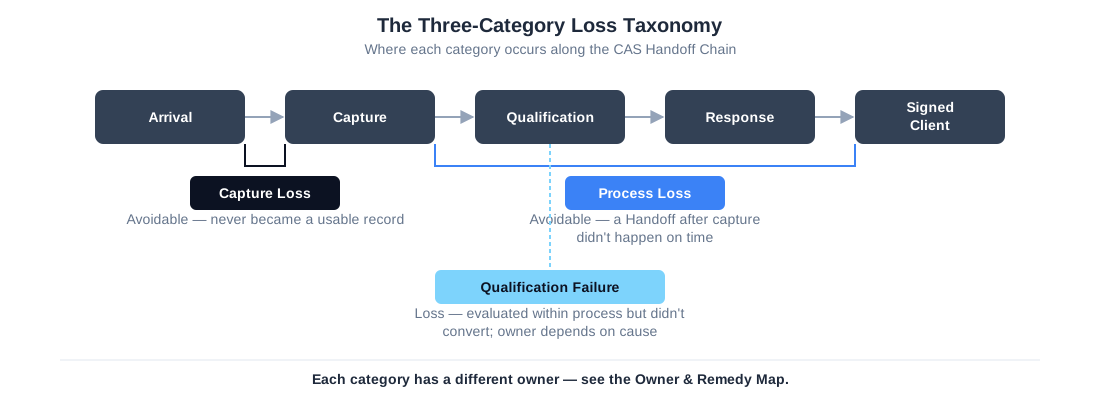
Why every side has a partial truth
Each party sees a different slice of reality, and each slice is genuinely true as far as it goes. Managing partners see rising acquisition costs and flat or disappointing signed‑case volume. They reasonably ask whether the leads are worth what they cost, because that’s the number moving in the wrong direction on the report they read first. Agencies see impressions, clicks, form fills, and call volume. They see campaigns that meet or beat agreed‑upon metrics, and conclude — not unreasonably — that demand is being generated as promised. Intake and operations teams see busy days, full queues, and constant fire‑fighting. From where they sit, they are working hard with the tools and staffing they have, and the complaint feels like it’s blaming effort rather than results.
Without more granular Visibility, none of these perspectives can be definitively confirmed or disproved. Each party is arguing from partial information, and the structure of the reporting — one blended conversion number, reviewed monthly — makes it genuinely hard to know who is right. This isn’t a failure of any individual’s judgment. It’s a failure of the data to distinguish between causes that produce the identical symptom.
How the lack of a loss framework fuels the conflict
In the absence of the Capture / Process / Qualification framework, every “lost” case looks the same in the data. A prospect who never answered the phone again, a prospect who waited too long for a callback, and a prospect who was never a fit for the firm’s criteria all end up filed in the same undifferentiated bucket: no retainer.
That flattening has two consequences. It makes it easy for each side to assign blame in the direction that supports its own interests, because nothing in the report contradicts any of the three stories. And it makes it hard for leadership to know whether to invest in more demand, better intake, different filters, or some combination of all three — because the number that would tell them is the one number the firm never actually measures. The result is a recurring argument that burns trust and time every quarter but rarely changes outcomes, because the same ambiguous evidence gets reinterpreted by whoever is presenting it.
What a better conversation looks like
A healthier version of this conversation starts with shared facts instead of competing narratives. How many opportunities are lost to Capture Loss — prospects the firm never truly connected with at all? How many are lost to Process Loss — prospects engaged but not moved to retainer because a Handoff broke somewhere along the way? How many are true Qualification Failure — prospects who should not have been signed regardless of process, evaluated fairly and rejected on the merits?
Once those numbers come into focus, the discussion shifts from opinion to Diagnosis. If Capture Loss is high, marketing may well be doing its job — the firm needs better coverage and contact handling, not a different agency. If Process Loss is high, intake needs more support, clearer Operational Governance, or a different design, and agencies may be largely exonerated for that quarter’s shortfall.
If Qualification Failure is a large share and rising, there’s a further diagnostic worth applying before assigning it to either side. Because intake outcomes are tracked at the individual agent level, a firm can look at how Qualification Failures are distributed across the team over the same interval. If one or two agents show a meaningfully higher rate than the rest, that’s a strong, specific signal — Qualification Failure — Judgment: a training or coaching issue for those individuals, not a lead‑quality problem, and a concrete one to act on. If the rate is roughly even across the whole team, it’s unlikely everyone independently made the same bad call — the more likely explanations are the leads themselves, or a cause shared by the whole team, such as an outdated criteria checklist or a script that’s screening too hard. Where a firm also has reliable channel or source data, this sharpens further: if the rate moves with the source, that’s Qualification Failure — Lead Quality — evidence pointing at lead quality specifically, backed by a pattern rather than an assumption. Where source data isn’t yet clean enough to say, the honest label is Qualification Failure — Undetermined (Shared Cause): both explanations remain open, and the useful next step is a review of the qualification criteria itself, alongside starting to capture source data consistently, so the next quarter’s version of this same question is easier to answer.
No one’s perspective disappears in this framing. Each one gets anchored to a shared diagnostic map instead of floating free as an unfalsifiable claim.
Why this matters for firm culture
Beyond the economics, resolving this argument is about culture and decision quality. A firm that lives in a permanent blame loop around intake will struggle to make confident, large‑scale marketing decisions, because every proposal to increase spend reopens the same unresolved argument about whether spend was ever the problem. It will struggle to invest meaningfully in intake improvements, because any investment can be second‑guessed by whoever still believes the real problem is lead quality. And it will struggle to attract and retain strong operations leaders and agency partners, who have every reason to prefer a firm where problems can actually be diagnosed over one where every shortfall becomes a fresh round of finger‑pointing with the same inconclusive evidence.
A firm that can show, with data, where it is losing cases and why can have harder conversations, but cleaner ones: not “whose fault is this,” but “what part of the system needs to change, and how, and who owns making that change stick.” That is a fundamentally different kind of meeting, and it is only available to a firm that has already separated Capture Loss, Process Loss, and Qualification Failure well enough to know which one it’s actually looking at.