Most firms agree in principle that response time matters. Fewer have a concrete sense of what delay actually costs them in signed cases. The result is a dangerous illusion: as long as the team is “reasonably fast on average,” delays feel like a service issue rather than a yield issue — something that affects the prospect’s experience, not something that shows up as a specific, countable loss on the firm’s books.
This article connects timing directly to intake loss, extending the perishable inventory framing established earlier in the library into PI‑specific behavior.
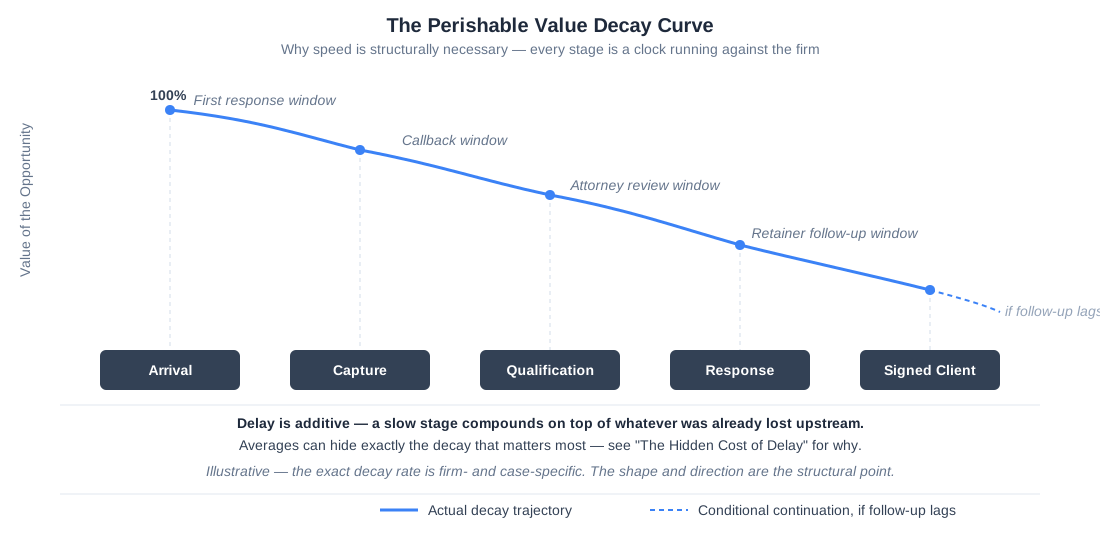
Why time is not neutral in intake
In a perishable inventory system, time works against you by default — that is the whole premise of treating intake as perishable rather than static. In PI intake, a prospect who has just reached out is in a narrow decision window. They may be contacting multiple firms simultaneously. They may be in pain, distressed, or overwhelmed by a situation they didn’t choose. They may be trying to make a major decision quickly, precisely so they can return to other, more pressing parts of their life.
Every hour, and often every minute, that passes without meaningful engagement gives space for other outcomes: hiring another firm, deciding not to pursue a case at all, or simply becoming harder to reach and less willing to engage when the firm finally does call. From a yield perspective, a delayed response is not just slower service. It is a form of Process Loss that directly lowers the probability that the opportunity becomes a signed case, regardless of how well the firm eventually handles it once contact is made.
The compounding effect of delay across stages
Delay rarely happens at just one point. It accumulates across the intake chain: a slower first response after initial contact, a lag between initial intake and attorney review, a lag between attorney recommendation and retainer follow‑up, and a lag in recovering stalled or incomplete intakes that fell through a gap somewhere in the process.
Each delay nudges the prospect further away from ready‑to‑sign. By the time the firm reaches out again, the opportunity may technically still be open on paper, but the emotional and practical urgency that made it attractive in the first place has already decayed. Because these delays happen at several stages rather than one, their combined effect on yield is often larger than anyone expects from looking at any single delay in isolation — a firm that is only moderately slow at three different Handoffs can lose far more yield than one that is badly slow at just one.
Why averages understate the problem
Many firms track average response time or average time to review, and both numbers can be quietly misleading. A five‑minute average may include a mix of very fast responses and a meaningful tail of cases that waited twenty or thirty minutes — long enough for some prospects to move on entirely. A one‑day average review time may hide cases that actually sat three or four days because they landed before a weekend or during a staffing gap that the average simply absorbs into itself.
In practice, it is the tail — the delayed cases, not the typical ones — that drives a disproportionate share of Process Loss. Focusing only on the average masks the exact scenarios that need attention, because the firm’s own reporting tells it that performance is fine on the metric it’s watching while a specific, recoverable pocket of loss keeps recurring underneath.
Why delay is often invisible in reports
Standard intake reports typically show counts and outcomes, not the time those cases spent at each stage. Unless someone is looking at time‑to‑action metrics by stage and by Handoff specifically, the pattern of delay remains anecdotal: we were busy last week, the phones were slammed on Monday, that attorney is sometimes slow to review. Each of those is a plausible, sympathetic explanation, and none of them is measured.
Without timing Visibility, delay remains a story rather than a measurable Source of Loss. That makes it hard to justify investment in staffing, Operational Governance, or process changes aimed specifically at speed, even when those investments would pay for themselves many times over in recovered yield — a business case built on “we were busy” doesn’t survive a budget conversation the way a business case built on measured Process Loss does.
Why this matters for how firms prioritize fixes
Understanding the hidden cost of delay changes how a firm prioritizes operational work. Some process changes that seem minor — governing one critical Handoff, or adding a specific escalation path — can have outsized yield impact because they remove a timing bottleneck that was quietly costing more than anyone had measured. Some “nice to have” improvements, by contrast, may matter less than they sound if they don’t materially affect time at key stages.
In a perishable demand system, time is one of the main currencies the firm is spending, whether it tracks that spending or not. Treating it as such turns “be faster” from a vague exhortation into a concrete design and Operational Governance problem, with specific Handoffs to fix and a specific yield recovery to expect from fixing them.