Many firms hesitate to tackle intake loss because they know their data is imperfect. Fields are missing, sources are inconsistent, notes vary in quality from one coordinator to the next, and historical tracking may be patchy in ways nobody fully documented. It is easy to conclude that meaningful Diagnosis is impossible until the data is fixed first, and to treat that as a reason to defer the whole conversation.
This article argues the opposite: imperfect data can still support useful Diagnosis, as long as the firm is honest about what it can and cannot yet tell them.
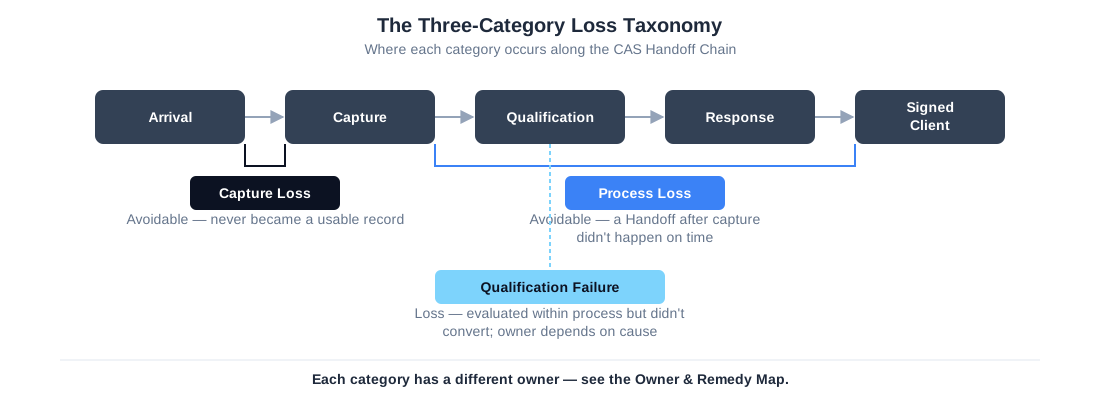
What imperfect data can still support
Even with messy systems, most firms can already see rough volumes by channel or source, basic stage progression — how many cases moved from inquiry to intake, from intake to review, from review to signed or not‑signed — some flavor of timing, even if only at coarse daily or weekly intervals, and outcome categories like signed, no‑hire, no contact, or did‑not‑qualify.
That is enough to begin approximating Capture Loss, Process Loss, and Qualification Failure in broad strokes. A firm may not be able to assign every case perfectly to one of the three categories, and a meaningful share will land in an honest “unclear” bucket rather than a confident one. But it can already begin to see where the largest pockets of loss are likely to sit, which channels or stages deserve a closer look first, and which parts of the operation are probably fine as they are. The point is not to produce a forensic report suitable for a courtroom. It is to be directionally right about where attention and improvement will have the most impact, starting Monday, with the data already sitting in the CRM.
Where current data usually falls short
At the same time, intake data in many firms has predictable limitations. Reasons for no‑hire or no‑engagement are often inconsistent, buried in free‑text notes that vary by whoever typed them. Fields get overloaded, with one label quietly covering several different situations that a firm would want to treat differently if it could see them separately. Timestamps are missing or unreliable at certain stages, especially for callbacks or internal Handoffs that were never built to be measured. And linkage between marketing sources and detailed intake behavior is often limited, so a firm can see what arrived but not always what happened to it in enough detail to be confident.
Those gaps make it genuinely hard to answer precise questions: how much of the firm’s Process Loss is specifically due to delay versus other kinds of process failure? How does loss behavior differ between referral, digital, and broadcast channels? Which specific Handoffs are responsible for the largest share of Process Loss, as opposed to Process Loss in general? Recognizing those limitations up front matters, because it keeps a firm from over-fitting confident decisions to details the data was never reliable enough to support.
Why data and operations improve together
A common fear is that “clean up the data” is a prerequisite project that has to be completed in full before any operational improvement can begin — that the firm needs a data initiative first and an intake initiative second. In practice, the two reinforce each other rather than waiting in line. As processes become more governed and consistent, the data captured about them naturally improves: events are recorded more reliably, fields get filled in as a matter of routine rather than an afterthought, and timing becomes more predictable simply because the process itself is more predictable. As data becomes clearer, it becomes easier to spot the operational gaps that are actually costing yield, which then drives the next round of process changes.
Rather than waiting for perfect data that may never arrive on its own, it is more effective to start with the best data available today, improve it alongside operations rather than ahead of them, and deliberately design new processes with data quality in mind from the outset, so the next round of Diagnosis is easier than this one.
How to use the data you have today
Practically, this means using existing fields and timestamps to estimate Capture Loss and Process Loss, even if some cases end up in an unclear bucket that the firm labels honestly rather than forces into a category it doesn’t belong in. It means identifying obvious outliers and patterns — sources with notably worse contact or conversion behavior, or stages with consistently longer times than the rest of the chain — and treating those patterns as worth a closer look rather than dismissing them as noise. And it means treating early findings as hypotheses to test with additional sampling, call listening, or manual review, not as final verdicts to act on irreversibly.
The goal is not certainty on day one. It is to move from “we don’t know anything” to “we know enough to prioritize a first wave of fixes,” and to let both operations and data quality improve together from there, each round making the next one more precise.