When intake results disappoint, most firms do not lack ideas. They lack certainty. Someone wants to hire more intake staff. Someone wants faster response-time scripts. Someone wants better reporting, a new CRM workflow, after-hours coverage, or AI at the front end. In almost every case, the firm is reaching for a Remedy before it has fully established the Source of Loss.
That instinct is understandable because Remedies feel like movement. They show urgency. They create the impression that leadership is acting decisively. But in intake, decisive action taken before real Diagnosis often means investing in the wrong fix, over-correcting the wrong stage, or solving only the most visible symptom while the real loss remains elsewhere.
That is why this tier begins with Visibility before action. Visibility is not hesitation. It is the operating discipline of seeing what is actually broken, how much it is costing, and where improvement should begin before committing resources to a fix. Without that step, firms often improve effort without improving yield.
Why firms jump to Remedies
The reason firms move too quickly to action is not irrationality. It is that the pain shows up in simple business terms — signed cases feel light, marketing spend feels high, partner confidence falls — while the causes remain scattered across channels, teams, and Handoffs. Because leadership feels the result clearly but cannot see the breakdown clearly, the organization tends to reach for whatever intervention is easiest to imagine.
That can produce sensible-sounding but conflicting proposals: buy more demand, tighten intake scripts, upgrade reporting, add automation, outsource overflow, press attorneys to review faster, or replace staff.
Any one of those could be the right move in a specific firm. The problem is that they cannot all be the first move. Some address Capture Loss. Some address Process Loss. Some address Qualification Failure. Those are different failure modes with different owners and different Remedies.
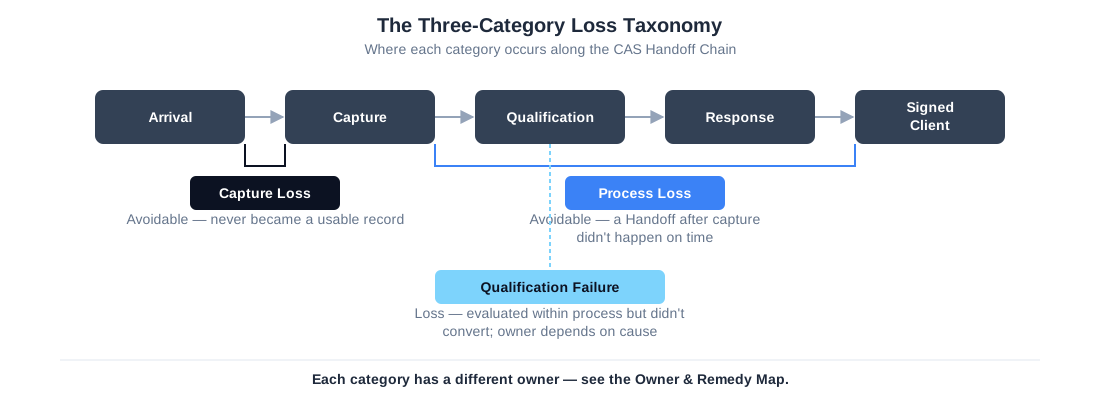
This is exactly what Visibility is meant to correct. It separates the feeling that “intake is underperforming” from the evidence of where cases are actually disappearing, and the basis to investigate why.
Visibility changes the quality of the decision
Visibility, in LexSteer’s language, means knowing exactly where the intake process is losing cases instead of guessing. That sounds straightforward, but its practical consequence is larger than it first appears. Once a firm can distinguish Capture Loss from Process Loss and Qualification Failure, the conversation changes.
Instead of “we need more people,” the question becomes: where is the loss concentrated, and what kind of loss is it? Instead of “conversion is weak,” the question becomes: weak because prospects were never logged, because Handoffs stalled, or because the underlying case quality was poor? Instead of “let’s fix the follow-up team first,” the question becomes: is follow-up actually the highest-cost bottleneck, or simply the most visible one?
That is the difference between a Remedy and the improvement a firm actually chooses. A Remedy is any plausible fix on the table before the firm knows what is actually broken. The chosen improvement is the specific fix selected once the Source of Loss is known. Visibility is what converts the first into the second.
This matters because the wrong Remedy can still create a lot of activity. It can even improve one local metric. But if it does not address the dominant Source of Loss, the firm has only spent money to feel busy.
Why the roadmap matters
A proper Visibility run surfaces the full set of losses and their impact at once, not one at a time. That changes how management plans improvement.
Without that broader view, firms often behave as if they must fix one thing, wait to see what happens, then go looking for the next issue. That creates a slow, serial improvement model in which the next fix waits on the last one. The problem is that intake loss is rarely that tidy. Multiple bottlenecks can exist simultaneously, and leadership often needs to prioritize them by economic significance, operational feasibility, and sequence of dependency.
A Visibility run makes that possible because it produces a roadmap rather than a single opinion. It shows not only where cases disappear, but which losses are largest, which are most preventable, and which are likely to yield the best return if addressed first. That allows the firm to plan several corrective moves coherently instead of lurching from one intervention to the next.
In other words, Visibility is not just a diagnostic step. It is a ranking step — the input leadership needs to prioritize.
Why action without Visibility can make things worse
There is another reason Visibility has to come before action: the wrong intervention can distort the system enough to hide the real problem even more effectively.
A firm that adds more top-of-funnel demand before addressing Process Loss may simply feed more prospects into the same fragile Handoffs. A firm that hires more intake staff before understanding Capture Loss may add cost without changing yield. A firm that presses harder on attorney review may create pressure in one stage while leaving a more damaging bottleneck unaddressed upstream. A firm that introduces automation into a badly diagnosed process may execute the wrong steps faster and more consistently.
In each case, leadership can point to action. It cannot yet point to control.
That is why Visibility is not the opposite of urgency. It is the only form of urgency that improves the odds of being right.