Many PI firms have capable, engaged operations leaders. They review reports, attend meetings, push for process improvements, and genuinely care about results. Yet even in those firms, significant operational loss often goes unnoticed for months — not because the leader is careless, but because caring and working hard are not the same thing as being able to see the problem.
This article explains why that happens, and why good operations leadership is necessary but not sufficient without the right Visibility and Operational Governance underneath it.
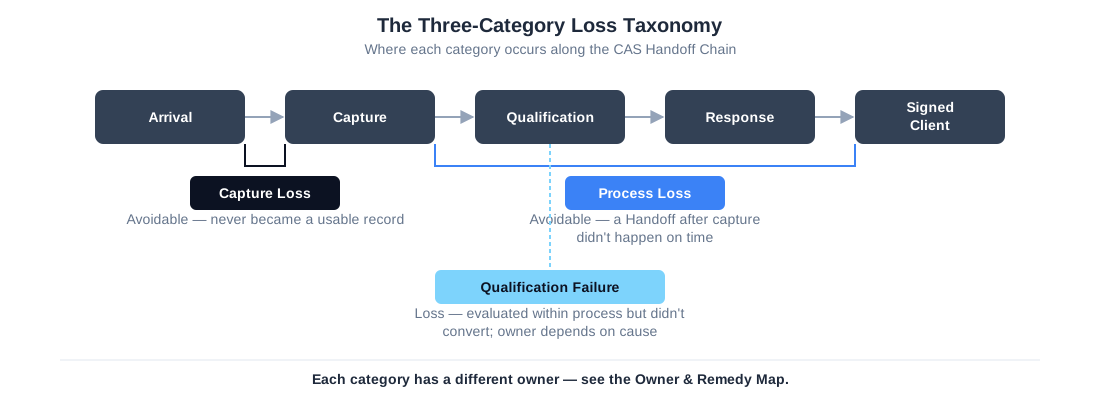
Those three categories are what a good operations leader is trying to see. The map below shows why the tools already in place aren’t built to surface them on their own.
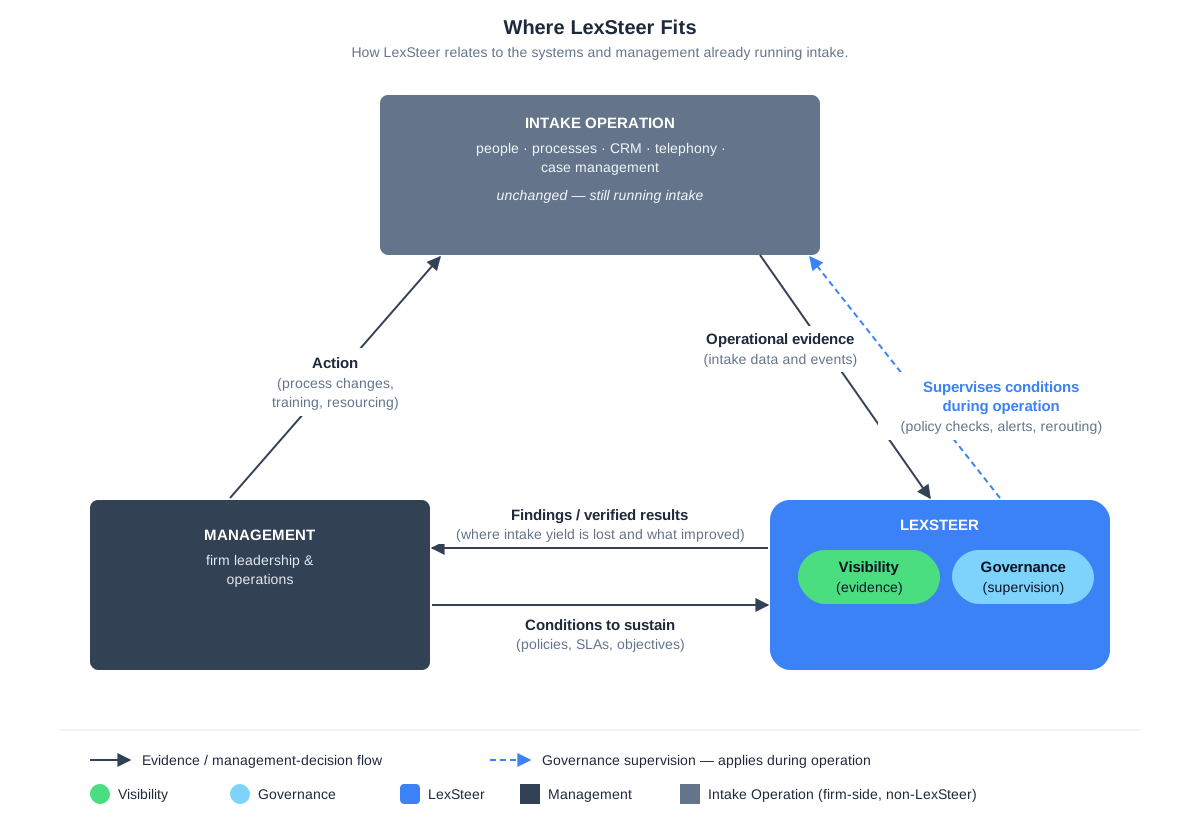
The limits of aggregate reporting
An operations leader can only act on what they can see. If their primary inputs are high‑level conversion reports, channel‑level acquisition metrics, and general queues and task lists, then much of the real operational failure will stay hidden from them no matter how carefully they read those reports. As earlier articles in this tier showed, the most damaging loss often happens in small, repeated failures at specific Handoffs: a subset of calls missed at certain times of day, cases that stall in particular review paths more than others, or patterns of delay concentrated in certain teams rather than spread evenly.
Aggregate reporting smooths those edges by design — that is, after all, what an aggregate is for. It tells operations that something is off, but not where or how in enough detail to intervene effectively. A leader staring at a conversion number that’s a point lower than last quarter has no way to tell, from that number alone, whether the cause is three missed calls a day at a specific location or a review queue that quietly grew from one day to three.
Overload and the “busy but blind” problem
Most operations leaders carry wide responsibility — intake, case management, staffing, vendor relationships, sometimes facilities and IT as well. Intake is one of many fires to manage, and rarely the loudest one on any given day.
In that environment, it is hard to sustain deep, continuous attention on specific intake Handoffs, because something else is always more urgent in the moment. Many issues get handled through ad hoc escalation and heroics when someone happens to notice a problem, rather than through any systematic detection. Process improvements are often designed and launched with real effort, but their long‑term adherence and effectiveness are difficult to track once the initial push fades and attention moves to the next priority.
The result is an organization that feels busy and engaged — because it is — but still loses a meaningful share of cases to Capture Loss and Process Loss that never register as distinct, solvable problems. They just register as a general sense that intake could probably be tighter, without anyone able to say exactly where or by how much.
Why process improvement is not the same as Operational Governance
Traditional process improvement efforts — mapping workflows, writing SOPs, training staff — are important and genuinely necessary. They define how things should work. But without Operational Governance actually watching whether critical Handoffs are happening on time, detecting when they are missed, triggering re‑routing or escalation, and verifying that recovery actually occurred, those improvements are vulnerable to Operational Drift. Over time, local shortcuts return, exceptions accumulate, and adherence declines quietly enough that no single week looks alarming.
Even a strong operations leader cannot manually enforce every critical Handoff in real time across every case, every shift, every day. That isn’t a competence gap; it’s a structural limit on how much any one person can watch continuously. Operational Governance is the mechanism that keeps process design and real‑world behavior aligned after the launch meeting is over. Without it, even excellent leaders are forced into periodic clean‑up rather than continuous control — rediscovering the same Operational Drift every few months instead of preventing it from accumulating in the first place.
What operations leaders need to be effective
To turn their effort into durable yield improvement rather than a recurring cleanup cycle, operations leaders need Visibility into where Capture Loss, Process Loss, and Qualification Failure are actually occurring — by stage, by source, by specific Handoff, not just in aggregate. They need timely signals when critical Handoffs stall, before cases quietly become lost rather than after a monthly report reveals it. They need clear rules and tools for re‑routing and escalation that do not depend on any one person’s memory or manual monitoring, because memory and manual monitoring are exactly what fails first under overload. And they need feedback loops that show whether changes are working and whether improvements are actually holding over time, rather than fading a few months after the initiative wrapped.
With those in place, the same leadership energy that was already there produces different results: fewer lost opportunities, fewer surprises at the monthly review, and fewer recurring arguments about what is really going wrong versus what only feels like it is. The leader’s judgment and effort were never the missing ingredient — the missing ingredient was a system built to show them what their attention alone could never fully cover.