Reporting, analytics, and a consulting engagement are all excluded by design from the job of improving intake: each gives the firm a read of the practice — sharper or duller, refreshed hourly or delivered once — but none of them is built to act on what it finds, or to keep re-reading as conditions drift. Even the read itself is partial: a dashboard, however real-time, is still a snapshot; a consulting engagement, however sharp, is still a one-time diagnosis. Real-time information without a real-time actor is just faster news, and a one-time diagnosis, however accurate, is still one-time.
That doesn’t make either one a bad instinct. When intake performance slips, asking for a better read — cleaner dashboards, tighter attribution, more complete funnel analytics, or an outside consultant who can look at the operation fresh — is reasonable. It’s just aimed at a different layer than the one that determines whether a firm keeps losing cases it already paid for.
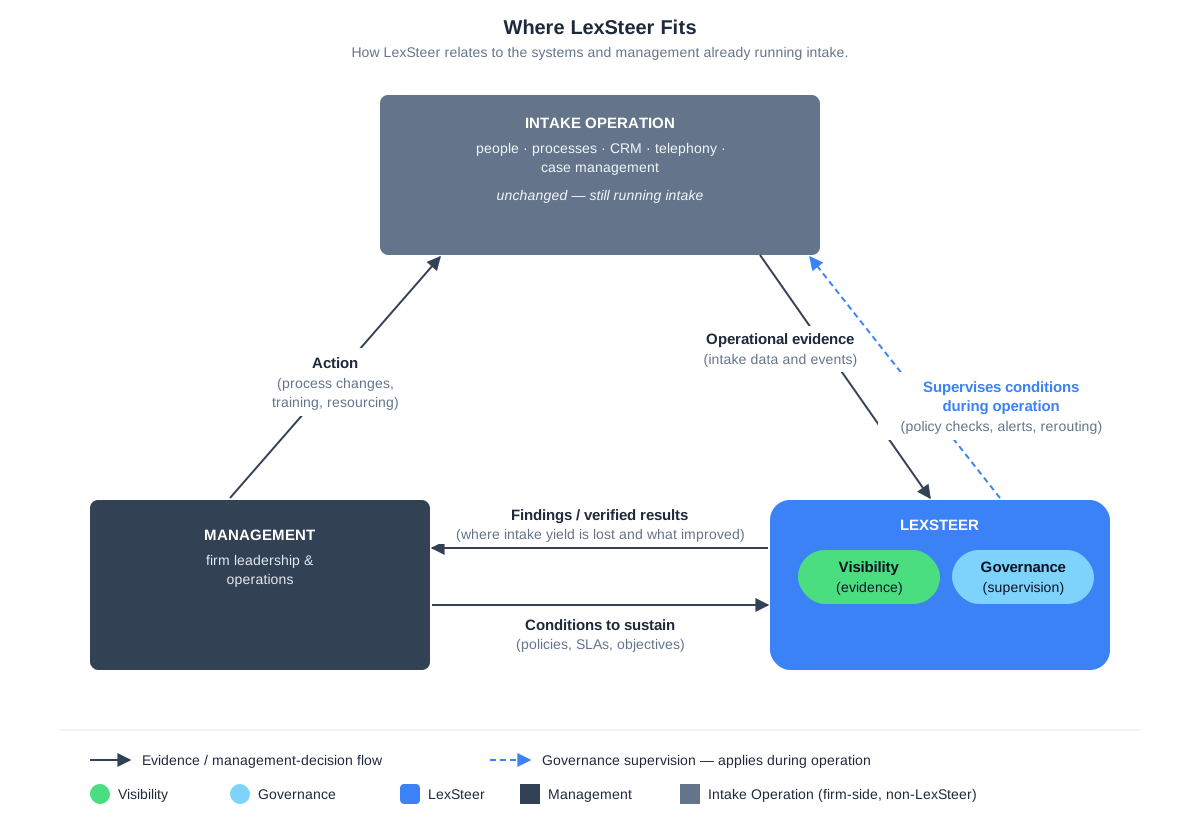
Reporting & BI is on the map above; consulting isn’t — it’s a service a firm buys, not part of its software stack — but it faces the identical limit described here. Both sit alongside the stack a firm already runs, informing it, diagnosing it, occasionally redesigning it, rather than sitting above it, watching whether the practice is actually improving and staying improved.
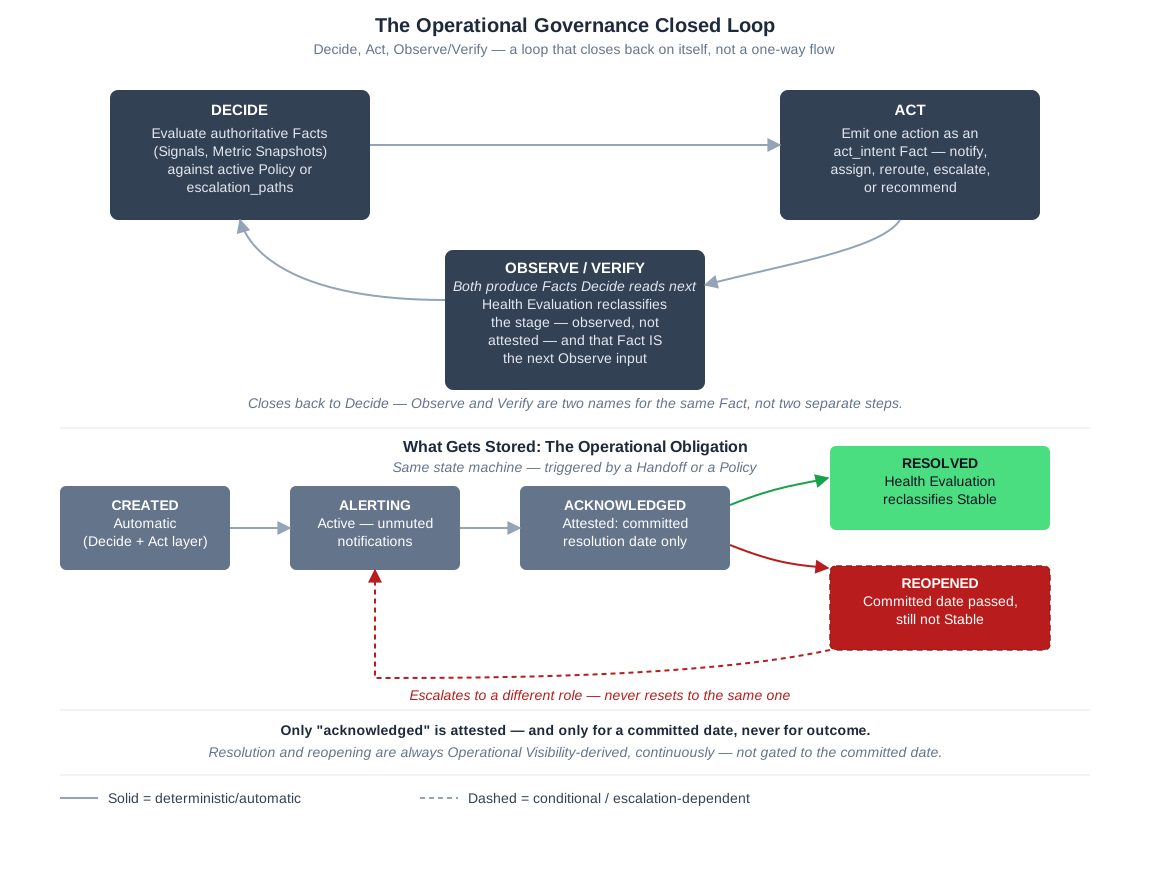
Snapshot versus trend
Most reporting, however current, is a snapshot: a state of the world at the moment the dashboard was viewed. A good analytics stack can even make that snapshot sharp — clean attribution, tight funnel views, reliable comparisons across channels and offices. None of that changes what kind of artifact it is.
Visibility is built to do something a snapshot cannot: track a Handoff’s behavior over time against the four-state Operational Drift model — Stable, Improving, Deteriorating, Unstable — and flag the moment it departs from Stable, while the departure is still happening. That is the difference between a report telling you response times were worse last week and a system telling you, right now, that this Handoff has crossed a threshold and needs a rule to fire.
Why real-time reporting still isn’t enough
It is tempting to assume the gap closes once reporting becomes fast enough. It does not, because speed was never the missing ingredient. A report that refreshes every second still only tells you something. It does not decide anything, act on anything, or verify that an action worked. Analytics has no actor behind it — nothing positioned to reroute a stalled callback, escalate an unanswered assignment, or confirm the case actually recovered. That absence, not the refresh rate, is the real limit.
This is what makes LexSteer’s Visibility a different kind of thing than BI, not just a faster version of it. Visibility feeds Governance directly: when a tracked Handoff’s behavior crosses a defined threshold, that Signal has a built-in consumer — a deterministic, rule-based response that fires without waiting for a person to notice the dashboard. That closed loop is what a report, however real-time, does not have.
It is fair to ask whether a report could simply be extended to close that gap itself — add an alert, notify someone when a metric crosses a line. It can, and some firms already try. But carried all the way through — detecting the miss, routing it to the right owner, escalating if the first attempt fails, and verifying the outcome — that extension is not a bigger report. It is Operational Governance, built under a different name. Most implementations stop well short of that, at “notify,” and quietly hand the closing of the loop back to a person who may or may not be watching.
The same gap in a human diagnosis
A consulting engagement is the same absence in a different form. A good consultant produces a real diagnosis: workflows reviewed, friction points identified, roles clarified, scripts and escalation logic tightened. That work can create immediate, real gains — intake becomes more organized, expectations become clearer. But it is still a snapshot, just a human one, delivered once rather than refreshed continuously. Consultants can recommend a better process and train people on it. They usually do not remain inside the live operation every day governing whether the redesigned process keeps happening as intended.
That is the same distinction between design and control that separates a report from a Signal. A process map, whether drawn by a dashboard or a consultant, can show who should act next; an Operational Governance mechanism determines whether the required Handoff actually happened, on time, and what the system does when it did not. A workflow can be redesigned correctly by an excellent consultant and still weaken over time as staff change and local workarounds emerge — and when results slip six months later, leadership often blames the engagement, when the more accurate conclusion is that the engagement improved the design, but no durable mechanism existed to detect Operational Drift early and recover critical Handoffs before the losses accumulated again. Diagnosis is not redesign, redesign is not governance, and neither one is the same thing as sustained improvement over time. Consulting can support that. It does not replace it.
The same gap shows up anywhere a tool tries to become the actor
This absence is not unique to reporting or consulting. Any tool that aspires to cover the same ground — a CRM logging that work is assigned, an automation platform firing a rule, even an AI system drafting or triaging — faces the identical question: is there a real-time actor behind it, or just faster information (or a sharper one-time opinion)? A CRM that only records is not different in kind from a dashboard that only reports; extending either one into a genuine closed loop means building Governance, whatever the product is called. Automation already fires reliably, but firing a rule is not the same as confirming it produced the intended result — that is a Governance question, not an automation one. And AI carries an additional wall on top of the same gap: even a fast, well-reasoned AI-generated action still has to be deterministic, repeatable, and explainable to be governable at all, which is the argument the AI article in this tier makes directly.
What this means for a PI firm
Reporting, analytics, and outside consulting remain genuinely useful — they make the practice legible, sharpen decisions, and can install real discipline where none existed. None of that is in question. What none of them can do, on their own or however sharp the read, is close the loop on a Handoff that is failing right now, or keep a fix from fading once the report is filed or the engagement ends. That is a different job, with a different required property: something built to act continuously, not just to inform or diagnose once.