The CRM is often the center of the intake operation, so when results disappoint, it is natural for leadership to look there first. The system contains the records. Tasks are assigned. Statuses are visible. From the outside, it can feel as if the CRM should already be governing the process, simply because so much of the process passes through it.
That assumption is where many firms confuse a system of record with a system of control. A CRM’s job is to run the practice — store the work, organize it, keep it moving. That is a real and necessary job. It is excluded from the other job, improving the practice, by function: it records that work was assigned, not that it was verified complete.
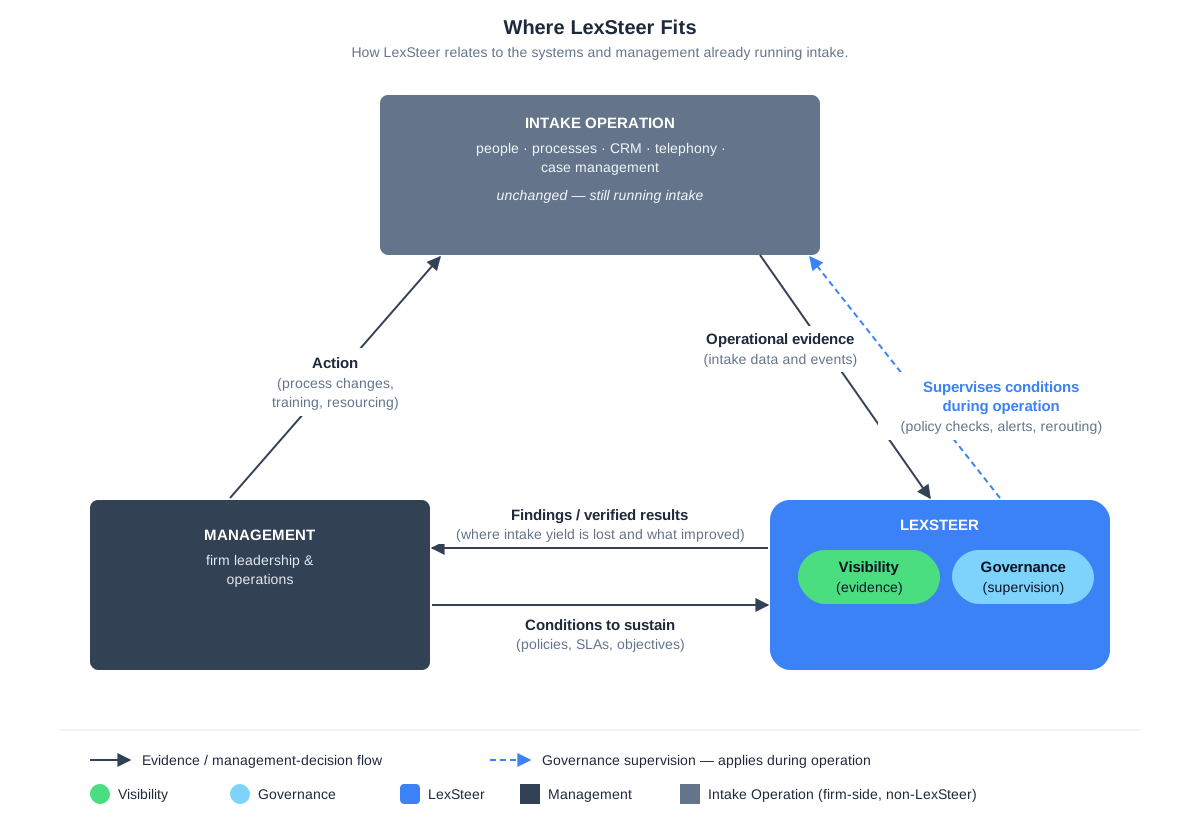
Recording is not enforcing
A CRM can assign a task without ensuring it was completed in time. It can show a status as unchanged without deciding what should happen because of the stall. It can record that attorney review is pending without rerouting the matter once the pending state has become dangerous. None of that is a defect — it is what a system of record is built to do. Governance is a different question entirely: has the required Handoff happened, within its time window; if not, who owns recovery now; when does escalation begin; and once something intervenes, was recovery actually verified?
This is why a firm can have a well-configured CRM — clean fields, sensible workflows, disciplined statuses — and still watch callback tasks sit too long, ownership go ambiguous, and cases age quietly toward loss. The record can be accurate and complete while the Handoff it describes is already failing.
“Couldn’t the CRM just be extended to catch that?”
It is a fair question, and worth answering directly rather than waving off: yes, a CRM can be extended toward this. Many already are — a rule that flags an overdue task, a notification when a status hasn’t moved, an alert routed to a manager. None of that is hypothetical; it is common CRM customization, and as far as it goes, it helps.
The honest limit shows up in what “all the way” actually requires. Detecting a stalled Handoff is one step. Deciding the correct recovery path, escalating when the first attempt fails, and verifying the case actually recovered are three more — and building all four, reliably, for every critical Handoff in the chain, is not a bigger CRM. It is Operational Governance, built inside the CRM under a different name. Most implementations stop at the first step, “notify,” and hand the rest back to a person who may or may not be watching when the notification arrives. A real-time alert is still just information until something is wired to act on it — the same gap that keeps a real-time dashboard from closing a loop on its own.
That gap is not specific to CRMs. Reporting and analytics face the identical absence of a built-in actor, for the same underlying reason. Automation reliably fires a rule, which is a genuine step further than a CRM’s notification — but firing is still not the same as confirming the rule produced the intended result, which is again a Governance question, not an automation one. And if a firm tried to close this loop with AI-driven judgment rather than fixed rules, it would run into a sharper wall on top of the same gap: a governed response has to be deterministic, repeatable, and explainable, which is a separate requirement from whether the judgment behind it is good.
What this means for a PI firm
None of this argues for replacing the CRM — a firm that dropped it would have less order, not more control. The CRM remains the right place to store the work, run the workflow, and hold the history. What it is not, however far it gets customized, is the mechanism that watches a Handoff in flight and makes sure it recovers. That is a distinct job, built to act rather than to record, and it is the job Visibility and Operational Governance exist to do.