A skeptical reader looking at LexSteer and the phrase Intake Yield Management is likely to ask a fair question: isn’t this just governance software with a new label? If a firm already has workflows in its CRM, queues in its call center, and automation wrapped around intake, why is that not already Operational Governance?
That question matters because category language shapes how buyers think. If the category is named too narrowly, the firm starts with the wrong mental model — shopping for more features inside tools it already has, instead of asking what discipline it is actually trying to practice.
The answer is straightforward. Intake Yield Management is the discipline. Visibility and Operational Governance are the mechanism beneath it. LexSteer is a product built to help firms practice that mechanism inside PI Intake Operations.
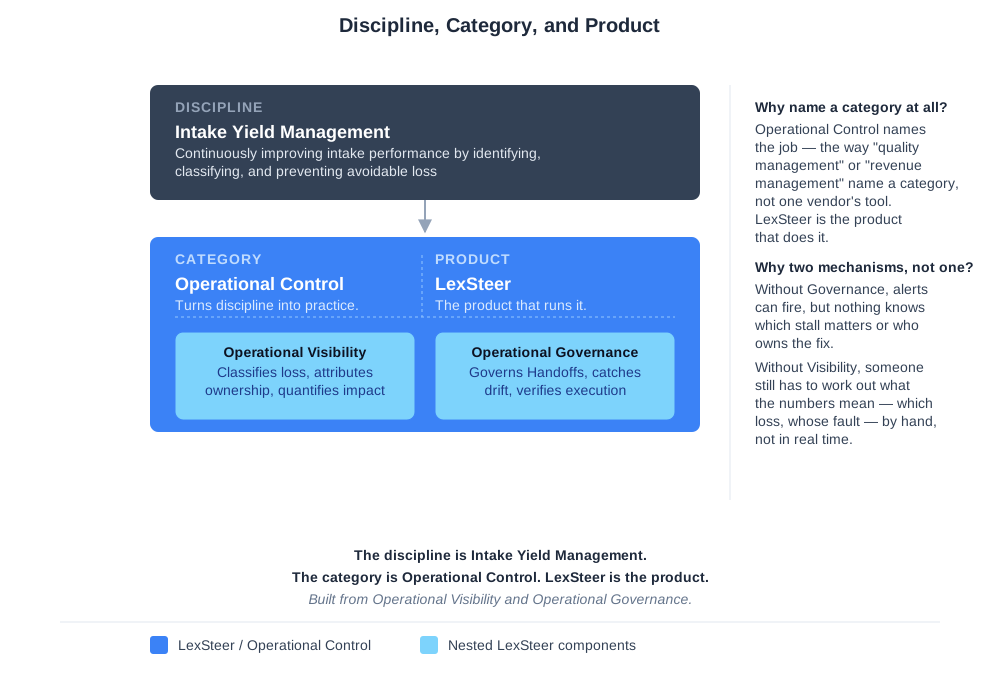
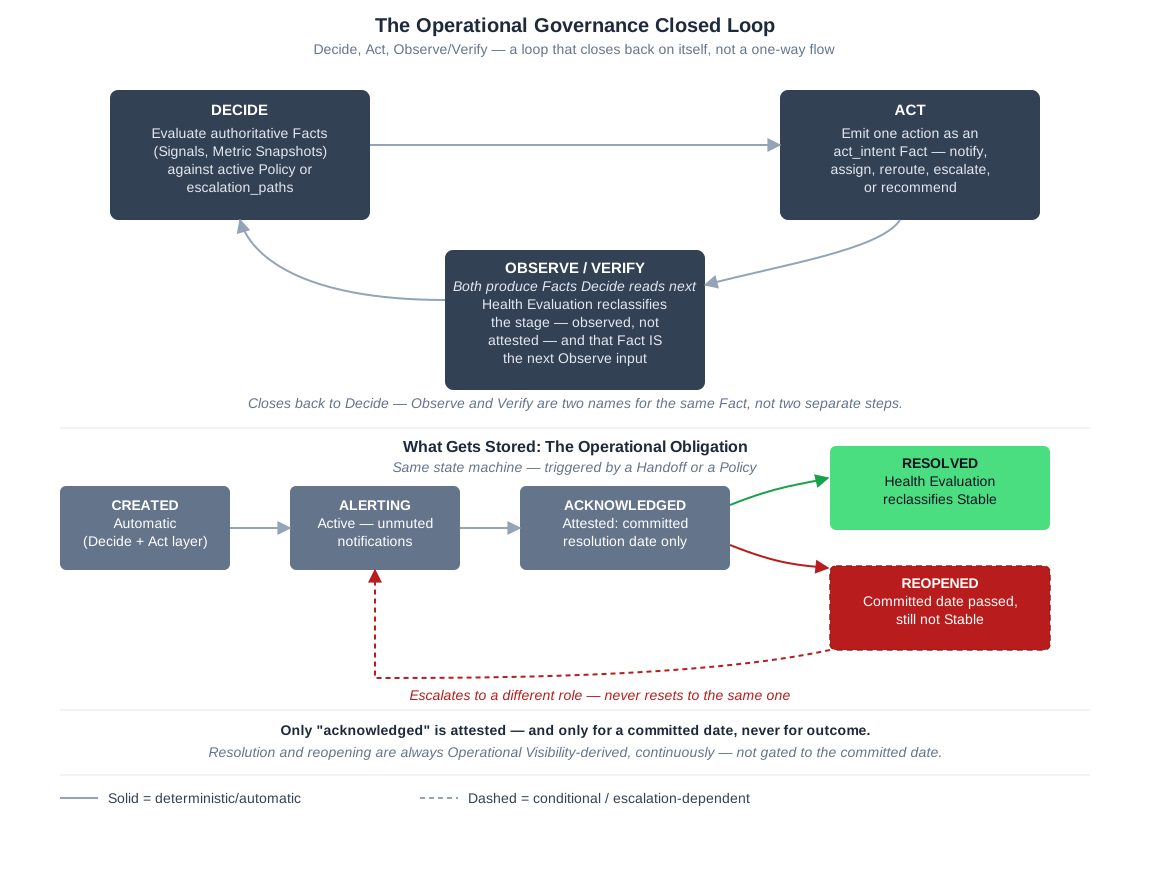
That hierarchy is the map. The loop below is what the mechanism layer actually does in live operations.
Discipline, mechanism, and tools
Most mature operational domains distinguish clearly between three layers. A discipline is the management standard or operating philosophy. A mechanism is the set of capabilities that makes that discipline practicable in live operations. Tools are the specific systems used to implement those capabilities. No one would confuse quality management with an inspection application, or revenue management with a pricing engine — the discipline is larger than any one tool, and the mechanism is larger than any one software implementation.
The same hierarchy applies here.
- Intake Yield Management is the discipline: continuously improving intake performance by identifying, classifying, and preventing avoidable loss between first contact and signed case.
- Visibility and Operational Governance are the mechanism: the capabilities that let a firm see loss clearly, govern critical Handoffs, and sustain improvements over time.
- LexSteer is one product designed to help firms practice that mechanism in PI intake.
Once those layers are separated, the category becomes easier to understand. The product is not claiming to be the discipline itself. It is helping firms practice the discipline with a defined mechanism.
Why governance alone is too narrow to be the category
It is tempting to make Operational Governance the headline category because the work is visible and concrete. It watches Handoffs, applies timing rules, escalates stalled work, and verifies recovery — tangible in a way broader discipline language may not feel. But governance alone is too narrow for the category claim. It sounds like a feature set or an extension of workflow software, and it does not capture the larger objective: preserving more value from paid‑for demand across a perishable, multi‑stage intake chain. Governance is essential, but it is still a means. Yield is the end. A category should describe the full management problem a firm is trying to solve — not merely governing steps, but continuously improving intake performance by identifying, classifying, and preventing avoidable loss between first contact and signed case. That broader problem includes Visibility before action, correct Diagnosis before Prescription, governed execution at critical Handoffs, and the sustaining logic that prevents Operational Drift from eroding gains over time. Operational Governance is indispensable inside that architecture, but calling the entire category “governance” would collapse a discipline into one of its mechanisms.
Why current tools feel close, but stop short
Part of the confusion is that many existing tools appear to do something adjacent to Operational Governance. CRMs assign tasks, store records, and track statuses. Automation enforces rules and triggers actions. Call centers extend coverage and improve live-answer performance. Reporting and analytics explain what happened after the fact. AI can accelerate bounded work inside the process.
All of those tools can be valuable. None of them, by itself, is designed to own intake yield across the full chain from first contact to signed case. Most stop short of governing that chain across critical Handoffs in real time, verifying recovery when things stall, and helping improvements remain effective as conditions change. A task can be assigned without being completed on time. A rule can fire without confirming the next stage was reached. A dashboard can explain yesterday’s miss without protecting today’s opportunity. In a perishable system, those are exactly the gaps where yield gets lost.
That stays true even as these tools get smarter. A more capable CRM, a better dashboard, or an AI-native platform that adds its own observe-and-act features still only sees its own slice of the chain, and still cannot independently verify whether its own actions held — the same reason a firm’s own staff cannot be the last check on their own handoffs. Owning intake yield end to end requires a layer built for that job specifically, not a byproduct of any one tool getting better at its own job.
What Operational Governance actually adds
Operational Governance adds closed-loop control behavior to live intake work: watching critical Handoffs against explicit timing expectations, detecting missed expectations, rerouting or escalating stalled cases, and verifying whether the case actually recovered. That is different from assigning a task, sending an alert, or firing a one-time automation — it does not just announce that something may be wrong, it carries the process toward a known outcome. That is why Operational Governance matters so much to the LexSteer story: it is the capability that helps improvements endure after management has identified what needs to change. And that closed-loop history is not just a claim made in a sales conversation — Operational Playback lets a firm move backward through its own record afterward and see, at any chosen moment, what stalled, what the system did about it, and whether the case actually recovered.
Why the distinction matters to buyers
For a managing partner, COO, or intake leader, this distinction changes the conversation. Framed as “we need more governance,” the next question is whether an existing CRM or vendor can add more control features — a tools-first conversation. Framed as “we need Intake Yield Management,” the questions become more useful: Where is yield being lost today? What kind of loss is it? Which Handoffs are load-bearing? What mechanism keeps improvements from fading after the first intervention? Those questions move the firm toward operating discipline, forcing clarity about Source of Loss, ownership, Remedies, and sustained improvement.
Why this fits LexSteer’s architecture
LexSteer’s website, product framing, and lexicon all make the same point. The first problem is that firms cannot reliably see where cases are being lost or distinguish one kind of loss from another. The second problem is that even real improvements often do not stay improved. Visibility addresses the first problem. Operational Governance addresses the second. Together, they support a cycle of Continuous Operational Improvement rather than a one-time project — which is why the architecture holds together more clearly when Intake Yield Management remains the discipline, and Visibility plus Operational Governance remain the mechanism beneath it. The distinction is not semantic housekeeping. It is what keeps the category honest and the buyer’s mental model accurate.
By the end of this article, a reader should be able to say three things clearly: Intake Yield Management is the discipline, not the product; Visibility and Operational Governance are the mechanism beneath that discipline; and existing tools may handle parts of the job, but they were not designed to own intake yield across a perishable, handoff‑heavy system. With that distinction in place, the rest of the library becomes easier to read — moving from category language to the more practical questions of where loss actually occurs, how firms misread it, what current tools solve, and how governed execution helps improvements hold over time.