Every PI firm loses opportunities between first contact and signed retainer. The question is not whether loss exists; it is where, and how much. Without that clarity, arguments about lead quality, intake performance, and “the market” never really resolve — they just recycle the same three opinions every time a monthly number disappoints.
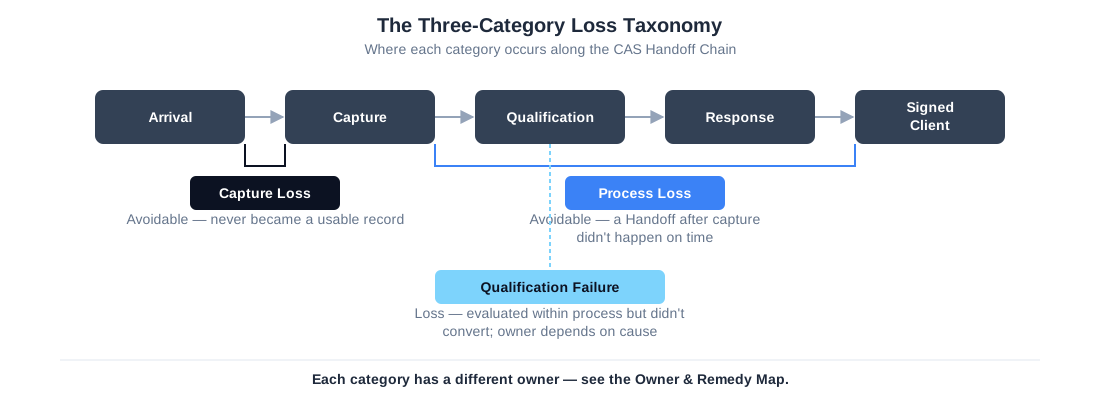
This article lays out the framework used throughout the LexSteer library: the three places cases disappear before retainer — Capture Loss, Process Loss, and Qualification Failure — and how to tell them apart in practice, not just in theory.
Telling Process Loss apart from Qualification Failure is the harder half of that — which is where Attribution Confidence comes in.
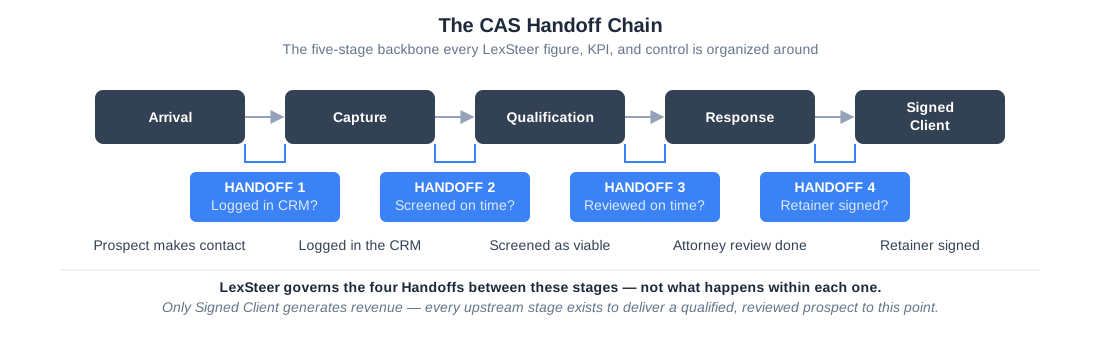
And all three play out along the same sequence every prospect moves through.
Capture Loss: the cases that never really arrived
Capture Loss happens when a prospect tries to reach the firm but never becomes a workable intake record. Common causes include missed calls and abandoned calls that are never re‑contacted, form fills that sit unworked for too long or are never seen at all, messages that reach a generic inbox but are never tied back to a specific person or case, and contact details that are incomplete or incorrect with no effective recovery attempt made.
In reporting, these prospects may appear as “leads” or “inquiries,” but operationally they never make it into a true intake pipeline. From a yield perspective, Capture Loss is the earliest and bluntest form of loss: paid‑for demand that never even gets the chance to be evaluated properly, because no one at the firm ever saw it as a live opportunity in the first place. Reducing Capture Loss requires both better coverage and better systems for surfacing missed attempts quickly enough to actually recover them, rather than discovering them weeks later in a data pull.
Process Loss: the cases that die in the middle
Process Loss occurs after a prospect has been captured into the system but before a retainer is signed, because the process itself fails them. Causes include delayed callbacks or follow‑ups that let interest decay, intake steps that stall when a staff member is out or overloaded, review queues where cases wait days for an attorney decision, ambiguous ownership that leaves a case “between” teams or individuals, and Handoffs that assume work was done without any verification that it actually was.
In data, these cases may show up as “no‑hire,” “no engagement,” “no retainer,” or similar outcomes. Without more detail, they are easy to misinterpret as Qualification Failure. In reality, many of them were winnable opportunities that slipped because the operation did not move fast enough or consistently enough at key Handoffs. Process Loss is where Operational Governance, timing expectations, and closed‑loop behavior make the most difference — it is the one category where a firm can materially change the outcome simply by changing how reliably it executes, without touching lead sourcing or criteria at all.
Qualification Failure: the cases you should not sign
Qualification Failure is different in kind, not just in cause. It refers to prospects who are not a good fit for the firm’s criteria even when everything goes right operationally: wrong injury type or practice area, weak liability or damages that do not meet economic thresholds, or jurisdiction, statute, and other structural factors that make the case genuinely non‑viable regardless of how it was handled.
These are legitimate “no” decisions. Trying to convert them would either harm the economics of the practice or violate the firm’s own standards. In a healthy system, a meaningful share of “no” outcomes will be true Qualification Failure — that is not a problem to be engineered away. The danger arises when Qualification Failure and Process Loss get blended together in the reporting. If cases that could have been signed are lost because of slow or inconsistent process, but they are recorded the same way as true non‑fits, leadership will systematically underestimate the firm’s avoidable loss and overestimate how much of its “no” pile was actually unwinnable.
Attribution Confidence: how sure can you be about a given “no”
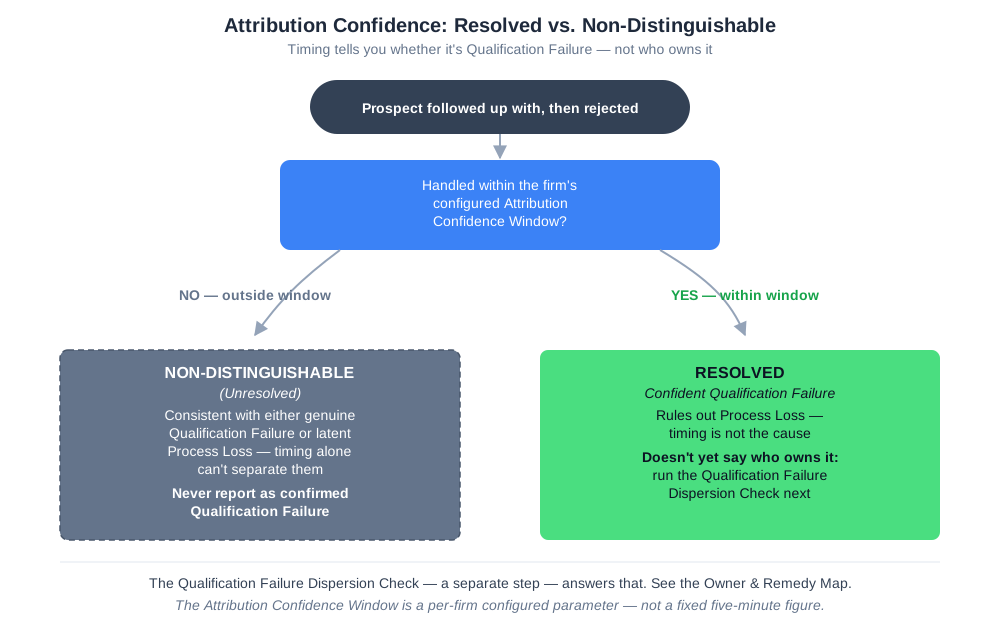
Separating Process Loss from Qualification Failure isn’t just a conceptual distinction — it can be measured, using response timing as the evidence.
A prospect handled within the firm’s configured Attribution Confidence Window and then rejected supports a Resolved, high-confidence Qualification Failure attribution. Timing has been ruled out as a contributing cause — but that alone doesn’t yet say whether the rejection reflects the case itself or an intake agent’s judgment call on a case that should have qualified; see “Why this framework matters,” below, and The Argument Every PI Firm Has for the Qualification Failure Dispersion Check that separates the two. A prospect handled slowly and then rejected is Non-Distinguishable: the outcome is consistent with either genuine Qualification Failure or Process Loss, and timing evidence alone cannot tell you which. That case may well have been a real “no” — but it may also have been a winnable case that decayed on the clock before anyone gave it a fair look, and the data cannot honestly distinguish the two.
This distinction carries a hard rule, not just a nuance: a Non-Distinguishable case must never be reported as a confirmed Qualification Failure in any aggregate statistic or partner‑facing claim. Doing so quietly launders Process Loss into a lead‑quality story, which is exactly the blending this framework exists to prevent. As a firm improves response times and pushes more cases under the timing floor, the Non-Distinguishable pool shrinks. The estimate of true Qualification Failure becomes sharper, the residual Process Loss becomes clearer, and the firm stops arguing about which side of the ledger a “no” belongs on.
This resolves a familiar three‑way dispute: marketing wants to know whether bad leads are the problem, intake wants to know whether it’s being blamed for cases that were never real fits, and leadership wants to know whether more spend is actually justified. Separating Process Loss from Qualification Failure with Attribution Confidence lets the firm answer those questions with data instead of guesses traded across a conference table.
Why this framework matters
The Capture / Process / Qualification framework is not a new buzzword. It is a practical way to tie intake loss back to specific kinds of failure, decide which problems are operational versus structural, and prioritize fixes that will actually reduce Lost Pipeline instead of spreading effort across everything at once.
Once loss is seen in these three buckets, decisions get clearer: Capture Loss and Process Loss both suggest operational work — coverage and front‑door systems for the first, governed Handoffs, timing standards, and escalation paths for the second. Qualification Failure resolves to one of three named outcomes: Qualification Failure — Lead Quality if the pattern tracks lead source, Qualification Failure — Judgment if declines concentrate with one or two agents instead, or Qualification Failure — Undetermined (Shared Cause) if the data is too thin to tell either way. The Qualification Failure Dispersion Check tells you which, rather than assuming either owner by default. The rest of this tier builds on this framework, and so does Visibility itself, further on in the library. Together, they move the firm from “we know we’re leaking somewhere” to “we know where, how much, and what to do about it.”