The growth problem PI firms can’t outspend anymore
For a long time, many PI firms could treat growth primarily as a marketing question: buy more demand, add channels, increase agency budget, and trust that more inquiries would translate into more signed cases. That strategy becomes fragile once acquisition costs rise and competition intensifies, because every avoidable loss inside intake turns paid‑for demand directly into revenue that never arrives.
Today, larger, better‑capitalized firms can often bid more aggressively for the same prospects and still come out ahead, because they convert a higher share of the arrivals they’re already buying. Smaller firms chasing that spend head-on are fighting on the one front they are least likely to win. The lever every firm still controls, regardless of size, is intake yield: what happens to paid‑for demand after it reaches Intake Operations.
This article makes the economic argument behind the promise of staying competitive as the market consolidates: why yield becomes more powerful than spend as acquisition costs rise, and why firms that keep treating intake loss as tolerable noise are effectively pouring marketing budget into Lost Pipeline.
Rising acquisition cost changes the math
When demand was cheaper and competition lighter, many firms tolerated more intake inefficiency than they realized. The waste stayed hidden inside headline metrics, and if monthly signed‑case counts looked acceptable, it was easy to respond to disappointment by buying more volume and assuming the system would correct itself.
That logic breaks down once cost per signed case starts climbing. A missed callback, a stalled review, a dropped form, or a missed after‑hours contact is no longer just an operational annoyance; it is paid‑for demand that consumed marketing budget and never became a client. The firm’s tolerance for invisible loss drops quickly, because every unworked opportunity now represents more expensive waste. Many leadership teams feel this shift before they can explain it — growth feels more expensive and harder to trust, and what used to look like ordinary intake noise starts to feel closer to capital misallocation.
Cost per signed case is the number that actually governs growth
Many firms still look first at lead volume, raw conversion rates, or monthly signed counts. Those numbers matter, but they can disguise the economics that determine whether a firm is truly competitive as the market consolidates. The number that captures the reality leadership cares about is cost per signed case: how much the firm has to spend to generate each retained client.
Two firms with similar headline conversion can live inside entirely different economic realities. One buys relatively efficient demand but loses a meaningful share to Capture Loss, Process Loss, and Qualification Failure that could be prevented. Another buys weaker demand but preserves more of it through disciplined intake, producing a lower cost per signed case. A third pays heavily for growth with no Visibility into which Source of Loss drives its waste, leaving leadership to argue about causes instead of measuring them.
Cost per signed case creates urgency, but it does not create Diagnosis. It tells the firm the problem is worth fixing; it does not say whether the primary driver is weak demand, Capture Loss, Process Loss, or unresolved Qualification issues.
Why “spend more” stops working in a consolidating market
When a growth engine underperforms, the easiest instinct is to spend more: buy more leads, add campaigns, push volume. That fails once the firm is already losing paid‑for demand after it arrives. Buying more demand simply pours additional budget into a system already turning part of that investment into Lost Pipeline. In a consolidating market, that effectively subsidizes stronger competitors — they convert more of what they buy, while the firm with leaky intake pays higher acquisition costs for the same or lower signed‑case yield.
The core economic shift is simple: marketing spend determines how much demand the firm can buy; intake yield determines how much of that demand becomes signed revenue instead of waste. Firms that treat yield as secondary will find themselves bidding against rivals who convert more of their arrivals, turning rising acquisition cost into competitive pressure on margins, distributions, and market position.
Yield is the lever every firm still controls
A PI firm grows in two broad ways: by buying more demand, or by preserving more of the demand it already paid for. Buying more demand is easier to explain — campaign launches, budget increases, new channels. Improving yield is quieter but often more powerful: it improves the return on spend the firm has already committed to making.
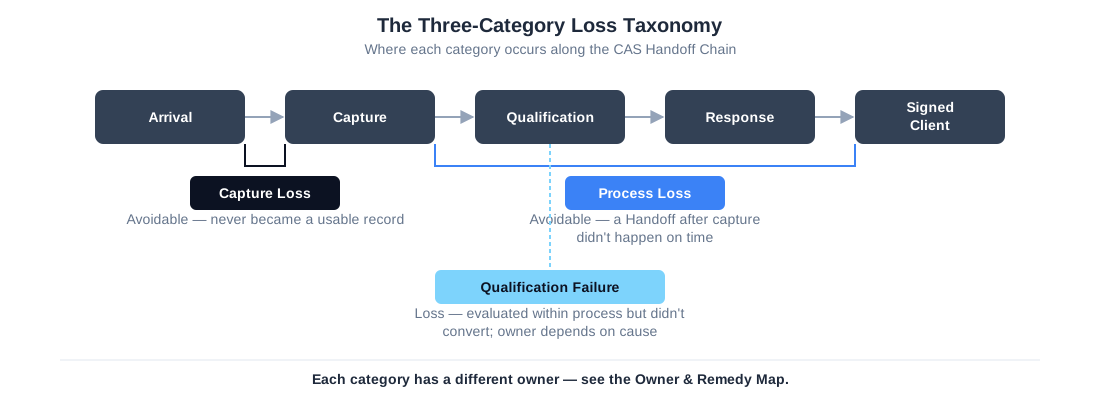
That is the economic logic behind Intake Yield Management. Once demand becomes expensive, the highest‑leverage growth decisions often live inside Intake Operations: reducing Capture Loss (inquiries that never make it into the system), addressing Process Loss (opportunities that stall before decision), and clarifying Qualification Failure (opportunities never likely to convert, so leadership can separate demand problems from operational ones).
Yield doesn’t compete with marketing. It is the discipline of preserving paid‑for demand so acquisition spend translates into signed revenue instead of Lost Pipeline — which is why Intake Yield Management is the category, and Visibility plus Operational Governance the mechanism beneath it. Once acquisition costs rise, firms that don’t treat yield as a first-class economic lever fall behind those that do.
Why this isn’t just a marketing story
It’s tempting to read rising acquisition cost purely as a marketing problem — channel mix, bidding pressure, agency performance. That framing is incomplete. Marketing shapes what kind of demand reaches the firm and what it costs, but once the prospect makes contact, the economics no longer belong to marketing alone. From first inquiry onward, the question is whether paid‑for demand becomes retained revenue or Lost Pipeline. Tracking acquisition cost without intake yield means leadership sees the cost side clearly while the loss side stays opaque — growth is visibly more expensive, with no confident answer for whether the fix is better demand, better execution, or better Diagnosis.
As cost per signed case rises, the ambiguity firms once tolerated becomes harder to justify. Leaders want to know not just that the system is underperforming, but where, and what it’s costing — the start of a more serious intake conversation, driven by economics that no longer give the firm permission to ignore intake loss.
What comes next in the series
This article’s job is narrow: make the economic case for why yield beats spend in a consolidating market, and why rising acquisition costs force firms to treat intake loss as a capital‑allocation problem rather than middle‑management friction.
From here, the reading path moves into Diagnosis: Why Conversion Rate Doesn’t Tell You What’s Broken explains why outcome metrics alone can’t distinguish Capture Loss, Process Loss, and Qualification Failure; The Three Places Cases Disappear introduces the Capture/Process/Qualification framework in full. Together, these build the bridge from economic urgency to operational Diagnosis — from feeling that growth is getting more expensive to knowing where loss is happening and what it costs.