Most PI firms do not suffer from having no tools. They suffer from having many tools, each doing a real job, without any one layer fully responsible for whether the live intake operation is actually holding together from first contact to signed case. Marketing systems create demand. CRMs store records and tasks. Analytics explain outcomes. Automation triggers actions. AI accelerates bounded work. Call centers improve coverage. Those are all legitimate functions, and most firms need several of them.
The problem is that none of those functions, by itself, is designed to govern the operation across critical Handoffs in real time. They support the intake system. They do not necessarily control whether the system is preserving yield as cases move through it. That is why firms can invest materially in their stack and still lose cases they already paid to acquire.
That gap does not close as any one of those tools gets more capable — including as AI-native platforms start describing themselves as observing activity, recommending action, and executing with an audit trail. Look closely and the pattern holds: the execution still runs inside a deterministic, gated layer, with AI assisting upstream of it, inside that one platform’s own slice of the stack. What is missing is not the ability to observe and act somewhere — it is a layer that watches the seams between whatever tools a firm actually runs and verifies outcomes independently of the system that produced them. That is a structural gap, not a maturity one.
This article is about that gap: the missing layer between systems of record and actual operational execution. Not a new category claim, and not a technical architecture diagram, but a clearer explanation of why modern intake operations still need a distinct layer dedicated to seeing loss, governing critical transitions, and keeping improvements from degrading over time.
What each existing layer does
The easiest way to understand the missing layer is to start by giving the rest of the stack full credit.
Marketing exists to generate demand. Agencies, ad platforms, and lead sources affect volume, quality mix, and acquisition cost. That is a necessary function, but it does not determine whether a given opportunity was captured, followed up on time, reviewed promptly, or recovered when it stalled.
The CRM exists to store information, track statuses, assign tasks, and provide a shared system of record. That matters enormously. But recording an assignment and governing a live Handoff are not the same thing.
Analytics and reporting exist to explain what happened. They help leadership see trends, volumes, and outcomes after the fact. They do not generally intervene when a case is still in flight.
Automation exists to execute pre-defined actions when conditions are met. It accelerates repetitive work and improves consistency. But triggered action is not the same thing as verified recovery when the intended path breaks.
AI exists to accelerate, structure, summarize, and support bounded decisions. It can improve responsiveness and reduce administrative load. It does not remove the need for a system that knows where critical loss occurs and what should happen when the live process deviates from plan.
Each of these layers can improve intake materially. None should be dismissed. But none fully owns the question that matters most inside a perishable-demand system: did the case move through the critical Handoff in time, and if not, was it recovered before value decayed?
What the missing layer actually is
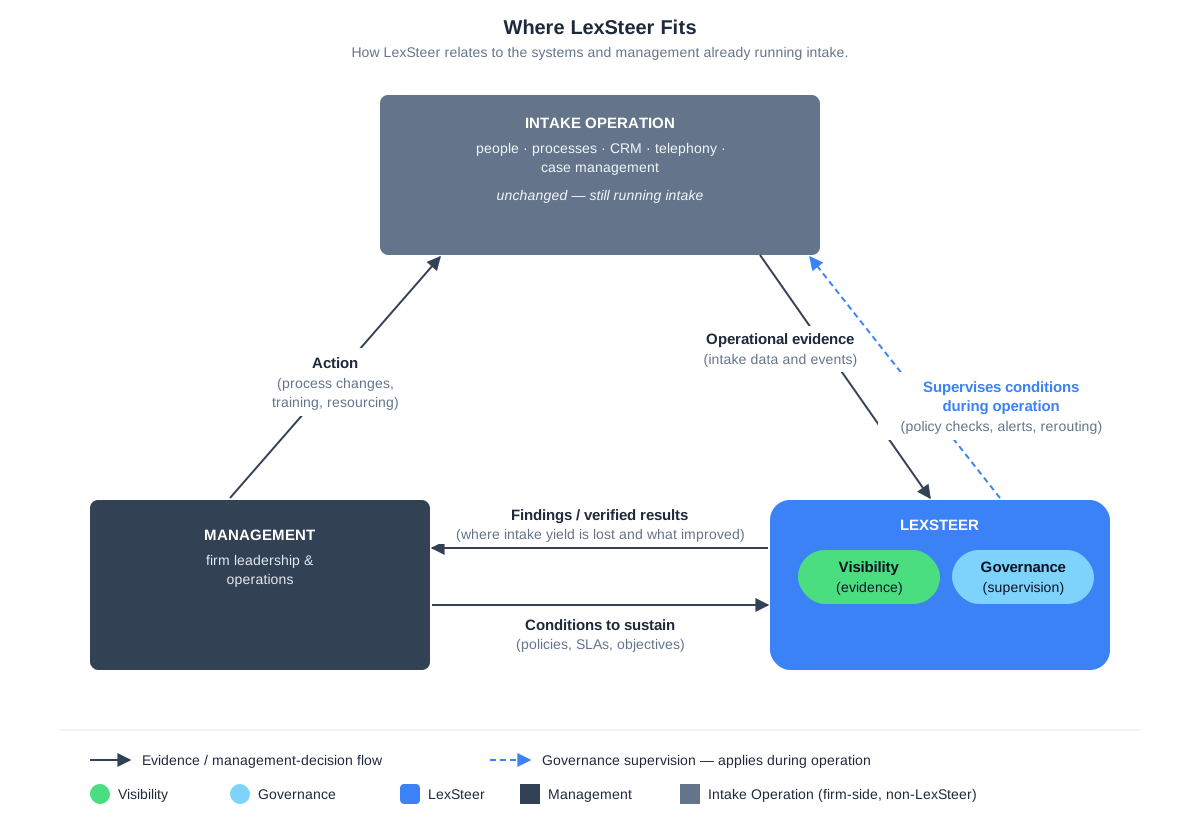
The missing layer is the one responsible for operational integrity across the intake chain. In LexSteer’s language, that means two capabilities working together beneath the discipline of Intake Yield Management: Visibility and Operational Governance.
Visibility makes loss measurable and attributable. It tells the firm where cases are disappearing and which Source of Loss is responsible. Governance acts on that understanding in live operations. It watches critical Handoffs, applies the firm’s rules for re-routing or escalation when a stall occurs, and verifies whether recovery actually happened.
That pairing is what turns the rest of the stack into something more coherent. Marketing can keep generating demand. CRM can keep recording work. Automation can keep executing tasks. Analytics can keep explaining outcomes. But without this additional layer, the firm is still depending on informal management effort to notice when the live process is failing and to rescue cases before they become Lost Pipeline.
This is why the article calls it a missing layer rather than a missing feature. Features live inside existing systems. A layer has a different job: it works across systems and teams, because the failure points it is meant to govern also occur across systems and teams.
Why some firms think they already have it
Some firms will read this and think, correctly, that they already perform parts of this work through people. An intake manager checks queues daily. A COO reviews reports and pushes on response times. A managing partner notices when signed volume feels soft and starts asking questions. Senior staff know which attorney needs follow-up and which team needs pressure. In that sense, a human-managed approximation of this layer often already exists.
That is true, and worth taking seriously — but the approximation is usually incomplete, fragile, and not timely enough to protect perishable opportunities at scale. It is incomplete because people are usually governing only the failures they can see. It is fragile because it depends on particular individuals, habits, and vigilance. It is not timely enough because a daily review, a weekly report, or an ad hoc escalation is often slower than the rate at which demand decays in PI intake.
That is why “we already manage this manually” is not really a rebuttal. It is evidence that the job exists. The question is whether the firm wants that job to remain dependent on heroics and memory, or whether it wants an operating layer designed to do it consistently.
Why this layer matters more as firms scale
The larger and busier a firm becomes, the less it can rely on direct personal knowledge to govern intake. A process that runs because the managing partner knows every important case is not an asset. It is a dependency. It does not transfer cleanly to a successor, scale with headcount, or survive sustained absence.
As staff change, priorities shift, and channels multiply, Operational Governance becomes more important, not less. More volume means more Handoffs. More Handoffs mean more opportunities for ambiguity, delay, and silent failure. The very growth a firm wants can make a loosely managed intake process less reliable if there is no dedicated layer protecting continuity and timing across the system.
That is also why this layer belongs beneath Intake Yield Management rather than beside it as a separate category claim. The discipline is the larger standard: continuously improving intake performance by identifying, classifying, and preventing avoidable loss between first contact and signed case. The missing layer is part of how a firm practices that standard reliably once operations become too complex to manage through instinct alone.
None of this has to be taken on faith, either in a sales conversation or eighteen months into a live deployment. Because Visibility and Operational Governance both operate on stored, timestamped facts rather than on memory or assertion, a firm can use Operational Playback to move backward through its own operational history and see, at any chosen moment, exactly what the system state was and what LexSteer was doing about it. The missing layer, once installed, is not just present. It is inspectable.